The rise of antibiotic resistance has been growing for around four decades. Now, artificial intelligence is becoming one of our most potent new weapons in the war against superbugs.
Picture yourself strolling into a hospital with a simple infection, one that would have been readily treated ten years ago. Now picture your doctor telling you the bacteria that are making you sick are resistant to a number of antibiotics and there are very few options left for therapy.
This is not Sci-Fi. This is an increasing reality in hospitals and communities across the globe.
Antimicrobial resistance (AMR) – the ability of bacteria and other germs to adapt and survive the medications designed to kill them – is one of the greatest risks to world health. Drug-resistant bacterial infections already kill more than 1.2 million people annually. If nothing more is done, by 2050 the number of deaths directly attributed to AMR might reach around 2 million per year, and the overall health burden associated with AMR could be over 8 million deaths per year.
It's a daunting task. But for the first time in decades, advances in artificial intelligence are giving scientists new techniques to identify, predict and combat antibiotic resistance.
The Problem: We're Falling Behind
Let's be honest about where we are.
Over the past four decades, despite the approval of various antibiotics, very few novel classes of antibiotics have been introduced into clinical practice. Most new antibiotics licensed are not novel solutions, but adaptations of old medications.
Meanwhile, bacterial resistance continues to evolve relentlessly.
Traditional antibiotic discovery is slow, expensive and hazardous. It can take more than a decade and billions of dollars to bring a new antibiotic from the lab to the market. The researcher may have to sift through dozens or even millions of compounds before finding a good candidate.
This leads to a dangerous imbalance: bacteria can become resistant in years, but it can take decades to produce new antibiotics.
The Solution: Meet AI
This is where artificial intelligence is disrupting the game.
AI is not just another tool in the toolbox, but rather a new strategy to solve one of medicine's most vexing difficulties. AI can sift through massive volumes of genomic, clinical and molecular data to uncover patterns humans could never hope to find by hand.
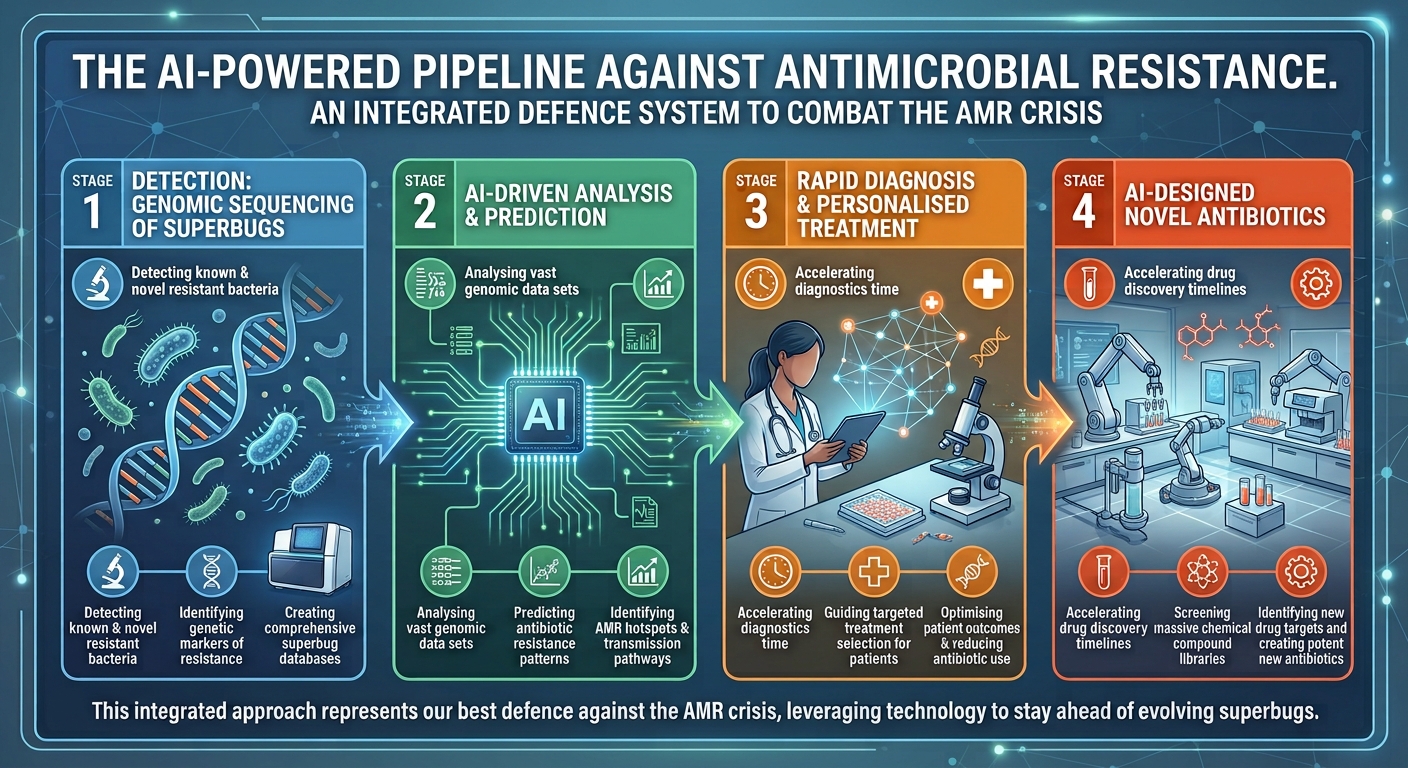
This is how AI is revolutionising the battle against AMR.
1. Preempting resistance before it occurs
Think about being able to see the next superbug coming before it turns into a major outbreak.
AI models trained on genetic and epidemiological data are starting to predict how bacterial populations might change over time. The devices can detect new patterns of resistance and allow hospitals to modify their antibiotic stewardship plans before resistance becomes widespread.
Preliminary studies demonstrate the potential of AI-supported antimicrobial stewardship programs to reduce needless antibiotic prescribing and to promote more precise decision-making in treatment. This helps keep existing antibiotics effective and reduces the development of resistance.
Instead of reacting to outbreaks, healthcare institutions should start predicting them.
2. Diagnosing infections in hours, not days
Time is one of the main obstacles in the treatment of bacterial illness.
Diagnostic procedures based on traditional culture can take days before clinicians know exactly which bacteria is responsible and which medications are likely to be effective. During this waiting period, physicians often resort to broad-spectrum antibiotics, which might promote resistance.
But this is a picture that is evolving with advances in whole genome sequencing and metagenomics.
The AI analysis of genomic data may identify pathogens quickly, and discover antimicrobial resistance genes within hours after sequencing is done. This will allow clinicians to select more targeted medicines earlier in the course of infection.
This leads to speedier treatment, better patient outcomes and less unnecessary antibiotic exposure.
3. Discovering New Antibiotics with Unprecedented Speed
One of the most exciting uses of AI is for drug discovery.
The conventional approach to antibiotic development entails time-consuming screening of large libraries of compounds. AI can enormously speed this up by searching chemical regions that would be impossible to search manually.
In 2025, MIT researchers used generative AI to create new antibiotic candidates that could be used to combat drug-resistant infections, including drug-resistant Neisseria gonorrhoeae and methicillin-resistant Staphylococcus aureus (MRSA).
The AI-based algorithm combed through millions of possible molecular configurations to identify compounds with potential antibacterial activity. Importantly, many of these compounds have chemical structures distinct from those of current antibiotics, paving the way for potential new treatment strategies.
The molecules are still in the research and development phase, but the work highlights how AI might greatly extend the hunt for future antibiotics.
"AI allows scientists to search through vast areas of chemical space that were previously out of reach using conventional approaches," said MIT researcher Professor James Collins.
4. Supercomputers in the fight against superbugs
Big pharmaceutical corporations and global health bodies have taken notice of the promise of AI.
GSK and the Fleming Initiative announced a £45m partnership in 2025 to use cutting-edge AI technology to combat antibiotic resistance.
The program intends to tackle numerous key concerns including:
- Speed up the finding of antibiotics against Gram-negative infections such as Escherichia coli.
- Developing medicines for dangerous fungal infections, such as Aspergillus.
- Predicting the emergence and spread of drug-resistant diseases.
- AI-assisted clinical decision-making for optimisation of antibiotic prescribing.
This shows a growing awareness that AI may be at the heart of the next wave of antimicrobial innovation.
Why It Is Important For Everyone
AMR is not just a concern for infectious disease professionals.
Modern medicine relies on effective antibiotics.
If they are not available, regular operations, organ transplants, cancer chemotherapy, critical care therapies and even births are far more perilous because of the threat of untreatable infections.
Now, about one in six lab-confirmed bacterial illnesses worldwide is due to antibiotic-resistant bacteria. In some places, like parts of Africa, the load is significantly greater.
The economic harm is no less disturbing. The burden of antimicrobial resistance (AMR) is great, costing tens of billions of dollars a year in health care expenses and threatening to overwhelm health care systems globally.
More critically it endangers the lives of millions.
The Path Forward
But AI isn't magic, no matter how promising.
There are a number of big hurdles need to be negotiated.
Infrastructure Deficiencies
Many low- and middle-income nations lack large-scale genome sequencing, digital health infrastructure and real-time surveillance systems. Without these tools, the benefits of AI could be unevenly distributed.
Bias and Data Quality
The quality of an AI system is directly proportional to the quality of the data it is trained on. Poor quality datasets or the under-representation of specific demographics can lead to skewed predictions and diminished effectiveness.
From discovery to practice
The computer can only guide you so far in finding potential substances. But new antibiotics still need to be validated in the lab, tested in clinical trials, approved by regulators and manufactured before they can reach patients.
Bridging that divide is one of the biggest problems in biomedical innovation.
Conclusion
For decades, antibiotic resistance has been progressively eroding one of the most fundamental successes of medicine – the ability to properly treat bacterial illnesses.
Our existing antibiotics are no longer effective. Old-fashioned drug discovery is still slow and expensive. Resistant infections are still spreading.
But for the first time in years, we have reason to feel optimistic.
Artificial intelligence is helping scientists predict growing resistance, detect illnesses faster, optimise antibiotic stewardship, and speed up the development of whole new antibiotic candidates.
The fight against AMR is not only a scientific task – it is a challenge to every patient who may one day need surgery, chemotherapy, intensive care or treatment for a dangerous infection.
The stakes have never been higher.
We understand. We have the tech. We have an opportunity to do something.
The fight against superbugs is being waged in labs, hospitals and research institutions around the world. AI is providing us a strong new edge.
Whether that edge is sufficient will depend on how fast we invest in research, develop surveillance systems and transfer innovation into real-world healthcare solutions.
It may be the future of modern medicine.

Microbiologist • Bioinformatician • AI/ML Researcher