Forget crystal balls. Bioinformatics is using algorithms to read your genome and tell you which diseases are lurking in your future, decades before symptoms appear. This isn't sci-fi; it's happening in labs right now.
Imagine walking into your doctor's office for a routine check-up. Instead of the usual blood pressure cuff and stethoscope, your doctor hands you a simple printout. It doesn't list your current cholesterol levels or vitamin deficiencies. Instead, it lists your future.
2032: Elevated risk of Type 2 diabetes – prevention plan recommended.
2041: 78% probability of cardiovascular event – lifestyle intervention suggested now.
2048: Low genetic risk for Alzheimer's – no action needed.
Sounds like science fiction, right? It's not. Welcome to the world of bioinformatics – the field that is quietly revolutionising medicine from the inside out.
What Exactly is Bioinformatics?
Let's cut through the jargon.
Bioinformatics is where biology meets data science. It's the discipline of applying computers to decipher biological data – especially, the enormous, mind-blowing volume of genetic data that today's technology can now produce.
Here's a way to look at it:
Your DNA is a 3-billion-letter instruction manual, written in a language you don't understand. Bioinformatics is the translator that converts those mysterious letters into life-saving predictions.
In the old days, a biologist would spend years in a laboratory, painstakingly working on one gene at a time. Today, a single DNA sequencing machine can decode your entire genome in a matter of hours – generating enough data to fill an entire laptop in just minutes.
The Data Tsunami: Why We Need Computers to Rescue Us
To appreciate why bioinformatics is so important, you need to understand the scale of the problem.
By the end of 2020, the European Bioinformatics Institute alone was storing more than 390 petabytes of biological data. To put that into context:
- 1 petabyte = 1 million gigabytes
- 390 petabytes could hold more than 80 billion high-resolution photos
- It's enough data to fill 10,000+ high-end laptops
- And it's growing exponentially – doubling every 14 months or so.
Without bioinformatics, all this data is just digital noise. With bioinformatics, it becomes a crystal ball.
How Bioinformatics is Changing Medicine
1. Predicting Your Future Health
This is the big one – and it's already here.
By analysing your complete genetic code, bioinformatics algorithms can identify mutations and genetic markers that are associated with specific diseases. This isn't guesswork; it's pattern recognition on a massive scale.
2. Personalized Medicine (Pharmacogenomics)
Why do some people respond well to a drug but others experience terrible side effects?
The answer is in your DNA. Bioinformatics analyzes your individual genetic profile to determine how you metabolize medications. This leads to:
- No more trial and error with drug prescriptions
- Reduced risk of adverse drug reactions
- Increased likelihood that your treatment will be effective
Welcome to personalized medicine.
3. Faster, Smarter Diagnosis
Traditional diagnosis takes days – sometimes weeks. Bioinformatics algorithms can analyse genetic data from a blood sample or tissue biopsy and identify pathogens or cancer markers in hours or even minutes.
During the COVID-19 pandemic, bioinformatics was instrumental in:
- Sequencing the virus genome in record time
- Tracking variants as they emerged globally
- Accelerating vaccine development
4. Drug Discovery at Warp Speed
Developing a new drug traditionally takes 10-15 years and costs over $2 billion. Bioinformatics is slashing both.
AI-powered algorithms can now:
- Predict how a drug will interact with a target protein
- Identify existing drugs that could be repurposed for new uses
- Create new molecules from scratch
The Big Picture: A $55 Billion Industry by 2035
Bioinformatics is not a niche academic discipline – it is one of the fastest-growing industries in the world.
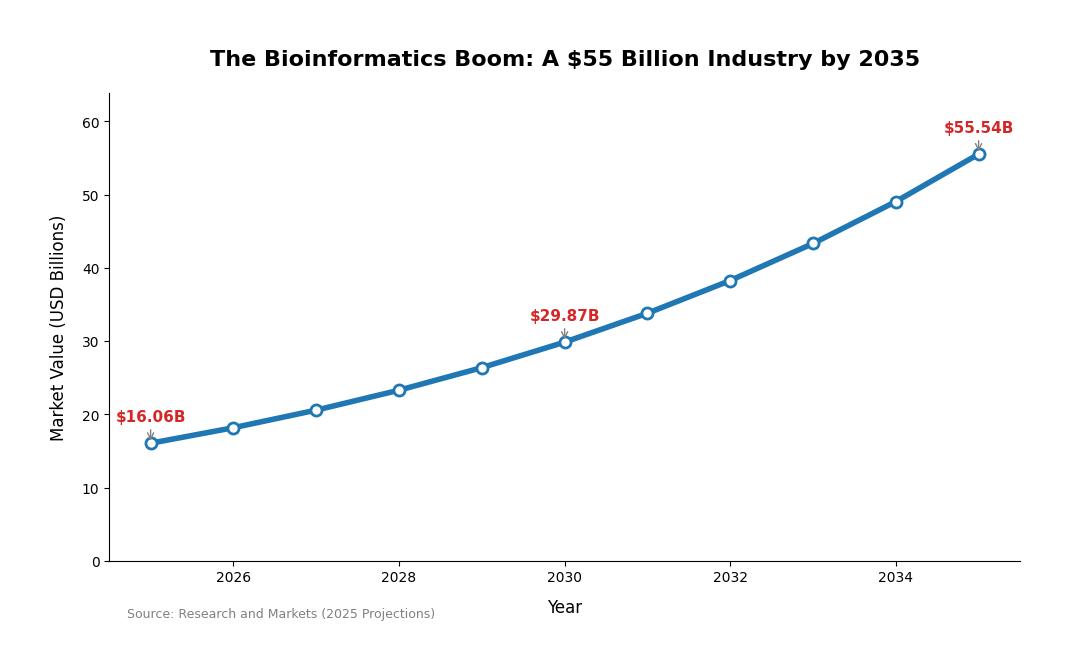
In 2025, the global bioinformatics market was valued at $16 billion. By 2035, it's projected to reach $55 billion – a staggering 13% annual growth rate.
Why is it growing so fast?
- Genomic sequencing costs have dropped from $100 million (2001) to under $200 today.
- Hospitals are adopting personalised medicine at scale.
- Pharmaceutical companies are racing to use AI for drug discovery.
- The global population is aging – and aging populations need more medicine.
The Challenges We Can't Ignore
Of course, it's not all smooth sailing. Bioinformatics faces significant hurdles:
- Data Privacy – Your genome is the most intimate data you own. Who gets to see it? How is it protected?
- Storage and Infrastructure – We're generating data faster than we can store and process it.
- The Skills Gap – There's a massive shortage of people who understand both biology and computer science.
- Interpretation Challenges – Having the data doesn't always mean we know what to do with it. The human genome is still full of mysteries.
- Access and Equity – Is bioinformatics for everyone, or just the rich?
What This Means for You
Let's make this personal.
In the next decade, bioinformatics will probably touch your healthcare journey in ways you never dreamed of:
- Your newborn's genome will be sequenced at birth to identify potential health risks.
- Your annual check-up might include a blood test that analyses thousands of biomarkers simultaneously.
- Your treatment plan won't just be based on your disease – it'll be based on you.
In short: medicine will become predictive, not just reactive.
Instead of treating diseases after they appear, your doctor will have a roadmap of your future health – and a chance to intervene before you ever get sick.
Final Thought: The Future is Already Here
"The code of life is written in a language we are only beginning to understand. But with bioinformatics, we are finally learning to read it – and what we are discovering will change medicine forever."
We are living through a revolution in healthcare – one that will see us transition from reactive, trial-and-error medicine to predictive, personalised, and precise healthcare.
Your doctor is about to know your medical future before you get sick. And that's a good thing.

Microbiologist • Bioinformatician • AI/ML Researcher