How Clusterin Protects Your Brain from Toxic Protein Accumulation
Imagine your brain has a garbage disposal system. It takes out the trash—damaged proteins, cellular debris, toxic aggregates.
Now imagine that system is broken. Trash piles up. The brain becomes clogged. And eventually, function fails.
That's what happens in Alzheimer's disease when amyloid-beta isn't cleared properly. And CLU is one of the key players in that cleanup system.
What Is CLU?
| Characteristic | Detail |
|---|---|
| Full name | Clusterin (also called apolipoprotein J) |
| Location | Chromosome 8 |
| Function | Amyloid clearance, lipid transport, complement regulation |
| Expression | Broad expression (brain, blood, other tissues) |
| Association with Alzheimer's | One of the most replicated genes after APOE |
CLU is your brain's cleanup protein.
How CLU Works
1. Amyloid Clearance
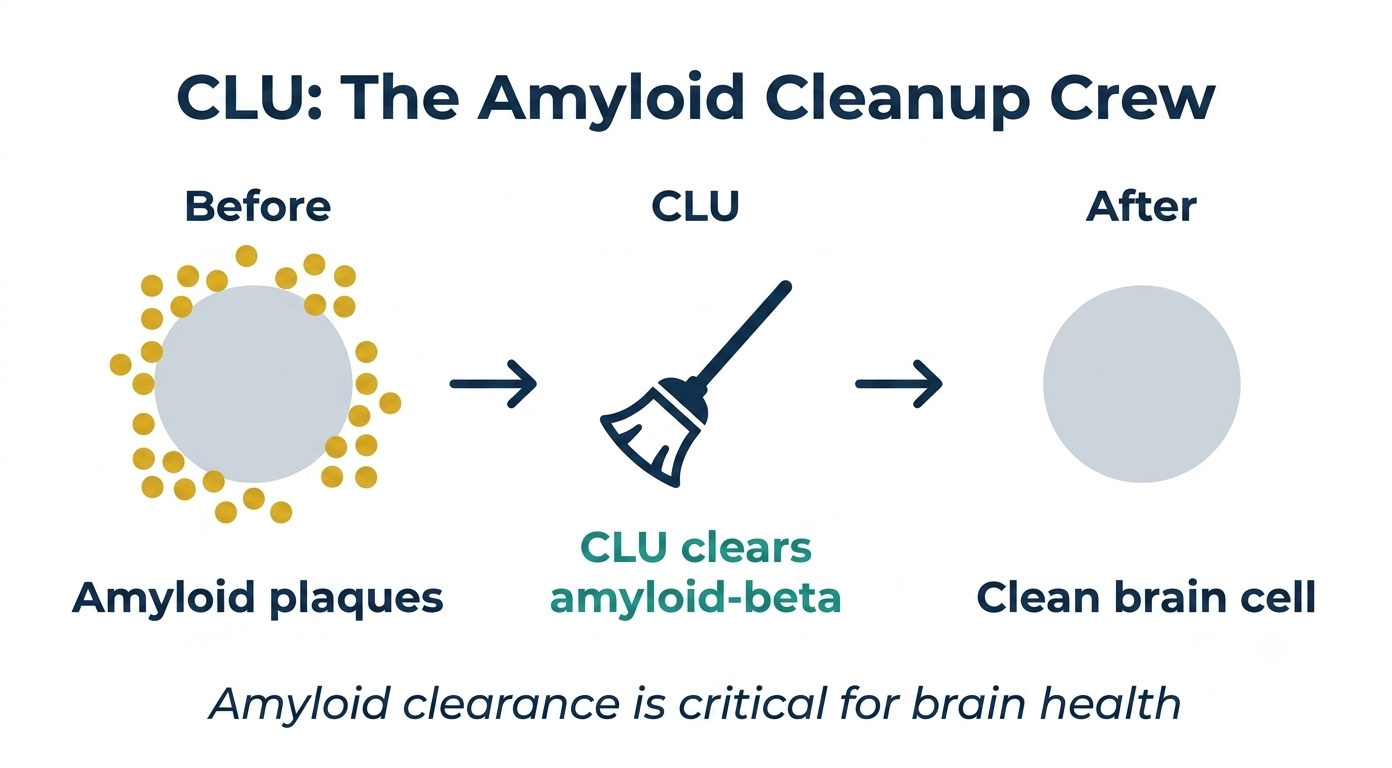
CLU binds to amyloid-beta and promotes its clearance:
| Function | What It Does |
|---|---|
| Amyloid-beta binding | Binds to amyloid-beta |
| Clearance | Promotes removal of amyloid-beta |
| Aggregation prevention | Prevents amyloid-beta aggregation |
2. Lipid Transport
CLU is involved in lipid transport:
| Function | What It Does |
|---|---|
| Lipid binding | Binds to lipids |
| Lipid transport | Transports lipids in the blood and brain |
| Cholesterol metabolism | Affects cholesterol homeostasis |
3. Complement Regulation
CLU regulates the complement system:
| Function | What It Does |
|---|---|
| Complement regulation | Modulates immune responses |
| Inflammation | Affects inflammatory processes |
| Cell survival | Protects cells from damage |
CLU and Alzheimer's
What We Found
In our gene-based analysis, CLU reached Bonferroni-corrected significance:
| Metric | Value |
|---|---|
| P-value | 1.80 × 10⁻¹⁰ |
| Significance | Bonferroni-corrected |
| Pathway | Amyloid clearance, lipid metabolism |
What This Means
| Implication | Detail |
|---|---|
| CLU is a true Alzheimer's risk gene | Highly significant association |
| Amyloid clearance matters | Implicates protein clearance |
| Lipid metabolism matters | Implicates cholesterol homeostasis |
| Works with APOE | Both are involved in lipid transport and amyloid clearance |
The APOE-CLU Connection
They Work Together
| Aspect | APOE | CLU |
|---|---|---|
| Function | Lipid transport, amyloid clearance | Lipid transport, amyloid clearance |
| Expression | Brain, blood | Brain, blood |
| Alzheimer's | Major risk gene | Major risk gene |
Why This Matters
| Implication | Detail |
|---|---|
| Convergent evidence | Two genes in the same pathways |
| Biological coherence | Consistent with known biology |
| Therapeutic targets | Two targets in one pathway |
| Network effects | Multiple genes affecting same process |
The APOE-CLU connection strongly implicates lipid metabolism and amyloid clearance in Alzheimer's disease.
Why CLU Matters
1. Amyloid Clearance Is Critical
Amyloid-beta accumulation is a hallmark of Alzheimer's disease:
| Observation | Implication |
|---|---|
| Amyloid plaques are a hallmark | Found in all Alzheimer's cases |
| Impaired clearance leads to accumulation | Clearance failure is key |
| Enhancing clearance could help | Potential therapeutic strategy |
CLU is essential for amyloid clearance.
2. Lipid Metabolism Is Connected
Lipid metabolism is linked to Alzheimer's in multiple ways:
| Connection | Detail |
|---|---|
| APOE | Major lipid transporter |
| Cholesterol | Affects APP processing |
| Lipid rafts | Affect amyloid production |
CLU's role in lipid metabolism connects it to APOE and other Alzheimer's genes.
3. CLU Is Connected to Other Alzheimer's Genes
| Gene | Relationship to CLU |
|---|---|
| APOE | Works together in lipid transport |
| ABCA7 | Lipid transporter |
| TREM2 | Microglial function |
CLU is part of a network of Alzheimer's genes.
The Evidence
Genetic Studies
| Finding | Implication |
|---|---|
| CLU variants are associated with Alzheimer's | Strong genetic evidence |
| CLU expression is altered in Alzheimer's | Functional relevance |
| CLU levels are elevated in Alzheimer's brains | Clinical relevance |
Functional Studies
| Finding | Implication |
|---|---|
| CLU binds to amyloid-beta | Direct involvement |
| CLU promotes amyloid clearance | Protective function |
| CLU affects lipid metabolism | Connection to APOE |
Therapeutic Implications
Potential Strategies
| Strategy | How It Would Work |
|---|---|
| Enhance CLU function | Promote amyloid clearance |
| Modulate CLU levels | Increase protective effects |
| Target CLU pathway | Affect downstream effectors |
Challenges
| Challenge | Why It Matters |
|---|---|
| Dual roles | CLU may have both protective and pathogenic effects |
| Context-dependent effects | CLU may work differently in different contexts |
| Need for specificity | Avoid unintended effects |
What We Still Don't Know
1. Which CLU Variants Are Causal?
We know CLU is associated with Alzheimer's, but we don't know which specific variants are causal.
2. How Does CLU Work in Different Cell Types?
CLU is expressed in multiple cell types. Its function may vary by cell type.
3. How Does CLU Interact with APOE and Other Genes?
CLU works with multiple genes. The details of these interactions are unclear.
4. Is CLU a Therapeutic Target?
We need more research to determine if CLU can be targeted therapeutically.
The Bottom Line
- CLU is a true Alzheimer's risk gene (P = 1.80 × 10⁻¹⁰)
- CLU is involved in amyloid clearance and lipid transport
- CLU works with APOE in these pathways
- CLU represents a potential therapeutic target
- More research is needed to understand CLU's precise role
Understanding CLU could help us enhance amyloid clearance and prevent protein accumulation in the brain.
Key Takeaways
| Finding | Implication |
|---|---|
| CLU = Alzheimer's risk gene | Strong genetic evidence |
| CLU clears amyloid-beta | Amyloid clearance is key |
| CLU works with APOE | Convergent evidence |
| CLU is a potential target | Therapeutic opportunities |
What do you think?
0 Responses
Osaghale L, Beshiru A, Subhan U. (2026). Replication-guided functional genomic prioritization of regulatory risk variants in Alzheimer's disease. Gene Reports. 44: 102551.
Code Availability: https://github.com/Oselin1988/GWAS_AD
Next post: "TREM2: The Microglial Receptor That Could Revolutionize Alzheimer's Treatment" — Coming soon!
← Back to Blog Home