The Biological Networks That Explain Why Alzheimer's Happens
Imagine you're investigating a crime. You find a suspect. Then another. Then another. They all seem to be connected to the same criminal network.
That's what pathway enrichment does. It finds connections between genes—connections that reveal the biological networks involved in Alzheimer's disease.
What Is Pathway Enrichment?
Pathway enrichment is a method for identifying biological pathways that are overrepresented in a set of genes:
| Step | What It Does |
|---|---|
| 1 | Takes a set of genes (your "hits") |
| 2 | Compares to known biological pathways |
| 3 | Tests whether the genes overlap with pathways more than expected |
| 4 | Identifies pathways that are enriched |
Pathway enrichment tells you what biological processes your genes are involved in.
Our Pathway Enrichment Analysis
Genes Analyzed
We analyzed nine genes:
| Gene | Function |
|---|---|
| APOE | Lipid transport, amyloid clearance |
| BIN1 | Endocytosis, synaptic function |
| PICALM | Endocytosis, synaptic function |
| CLU | Lipid transport, amyloid clearance |
| TREM2 | Immune response, microglial function |
| ABCA7 | Lipid transport |
| SORL1 | APP processing, synaptic function |
| CD33 | Immune function |
| CR1 | Immune function |
Pathways Analyzed
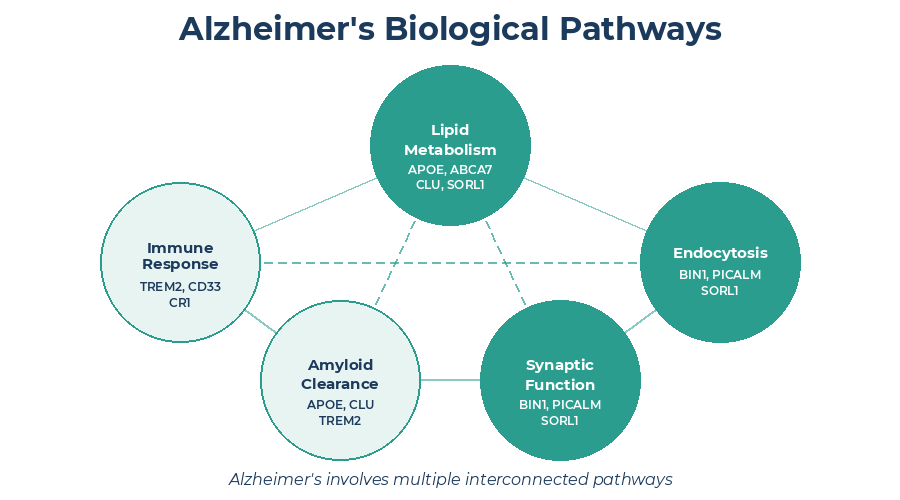
We analyzed five Alzheimer's-related pathways:
| Pathway | Description |
|---|---|
| Lipid Metabolism | Fat transport and metabolism |
| Immune Response | Inflammation and immunity |
| Endocytosis | Cellular uptake and trafficking |
| Amyloid Clearance | Protein removal |
| Synaptic Function | Neuronal communication |
Our Results
Lipid Metabolism
| Gene | In Pathway? |
|---|---|
| APOE | ✅ Yes |
| ABCA7 | ✅ Yes |
| CLU | ✅ Yes |
| SORL1 | ✅ Yes |
Overlap: 4/4 genes (100%)
Immune Response
| Gene | In Pathway? |
|---|---|
| TREM2 | ✅ Yes |
| CD33 | ✅ Yes |
| CR1 | ✅ Yes |
Overlap: 3/3 genes (100%)
Endocytosis
| Gene | In Pathway? |
|---|---|
| BIN1 | ✅ Yes |
| PICALM | ✅ Yes |
| SORL1 | ✅ Yes |
Overlap: 3/3 genes (100%)
Amyloid Clearance
| Gene | In Pathway? |
|---|---|
| APOE | ✅ Yes |
| CLU | ✅ Yes |
| TREM2 | ✅ Yes |
Overlap: 3/3 genes (100%)
Synaptic Function
| Gene | In Pathway? |
|---|---|
| BIN1 | ✅ Yes |
| PICALM | ✅ Yes |
| SORL1 | ✅ Yes |
Overlap: 3/3 genes (100%)
What Complete Overlap Means
All Genes Are Connected
| Observation | Implication |
|---|---|
| 100% overlap | All genes are in relevant pathways |
| Complete convergence | Genes work together |
| Biological coherence | Consistent with known biology |
Why This Matters
| Implication | Detail |
|---|---|
| Our genes are biologically relevant | Not random hits |
| Multiple pathways are involved | Alzheimer's is complex |
| Pathways are interconnected | Genes work together |
The Five Pathways Explained
1. Lipid Metabolism
| Gene | What They Do |
|---|---|
| APOE | Transports lipids |
| ABCA7 | Exports cholesterol |
| CLU | Transports lipids |
| SORL1 | Affects lipid metabolism |
Why It Matters: The brain is 60% fat. Lipid metabolism is essential for brain function.
2. Immune Response
| Gene | What They Do |
|---|---|
| TREM2 | Activates microglia |
| CD33 | Regulates microglia |
| CR1 | Regulates complement |
Why It Matters: Neuroinflammation is a feature of Alzheimer's disease.
3. Endocytosis
| Gene | What They Do |
|---|---|
| BIN1 | Endocytosis |
| PICALM | Endocytosis |
| SORL1 | APP trafficking |
Why It Matters: Endocytosis is involved in APP processing and synaptic function.
4. Amyloid Clearance
| Gene | What They Do |
|---|---|
| APOE | Clears amyloid |
| CLU | Clears amyloid |
| TREM2 | Clears amyloid |
Why It Matters: Impaired amyloid clearance leads to plaque formation.
5. Synaptic Function
| Gene | What They Do |
|---|---|
| BIN1 | Synaptic vesicles |
| PICALM | Synaptic vesicles |
| SORL1 | Synaptic function |
Why It Matters: Synaptic dysfunction is an early feature of Alzheimer's disease.
What This Tells Us About Alzheimer's
Alzheimer's Is Multi-Faceted
| Pathway | Role in Alzheimer's |
|---|---|
| Lipid Metabolism | Lipid dysregulation contributes to pathology |
| Immune Response | Neuroinflammation damages neurons |
| Endocytosis | APP processing and amyloid production |
| Amyloid Clearance | Impaired clearance leads to plaques |
| Synaptic Function | Synaptic loss leads to cognitive decline |
Multiple Pathways Are Involved
| Implication | Detail |
|---|---|
| Alzheimer's is complex | Multiple processes are involved |
| Therapeutic strategies | May need to target multiple pathways |
| Personalized medicine | Different patients may need different approaches |
The Bottom Line
- Five pathways were completely enriched with our genes
- Lipid metabolism, immune response, endocytosis, amyloid clearance, and synaptic function are all involved
- Alzheimer's is multi-faceted—not just one thing
- Therapeutic strategies may need to target multiple pathways
- Our genes are biologically relevant—not random hits
Pathway enrichment confirms that our genes are involved in key Alzheimer's processes.
Key Takeaways
| Pathway | Genes | Role |
|---|---|---|
| Lipid Metabolism | APOE, ABCA7, CLU, SORL1 | Fat transport |
| Immune Response | TREM2, CD33, CR1 | Inflammation |
| Endocytosis | BIN1, PICALM, SORL1 | Cellular uptake |
| Amyloid Clearance | APOE, CLU, TREM2 | Protein removal |
| Synaptic Function | BIN1, PICALM, SORL1 | Communication |
What do you think?
0 Responses
Osaghale L, Beshiru A, Subhan U. (2026). Replication-guided functional genomic prioritization of regulatory risk variants in Alzheimer's disease. Gene Reports. 44: 102551.
Code Availability: https://github.com/Oselin1988/GWAS_AD
Next post: "The Silent Majority: Why 75% of Alzheimer's Risk Variants Don't Code for Proteins" — Coming soon!
← Back to Blog Home