
The Overlooked World of Non-Coding Variants
When people think about genetic variants, they often think about mutations that change proteins. A typo in a gene that leads to a damaged protein. A broken code that causes disease.
But here's the thing: most of the genome doesn't code for proteins.
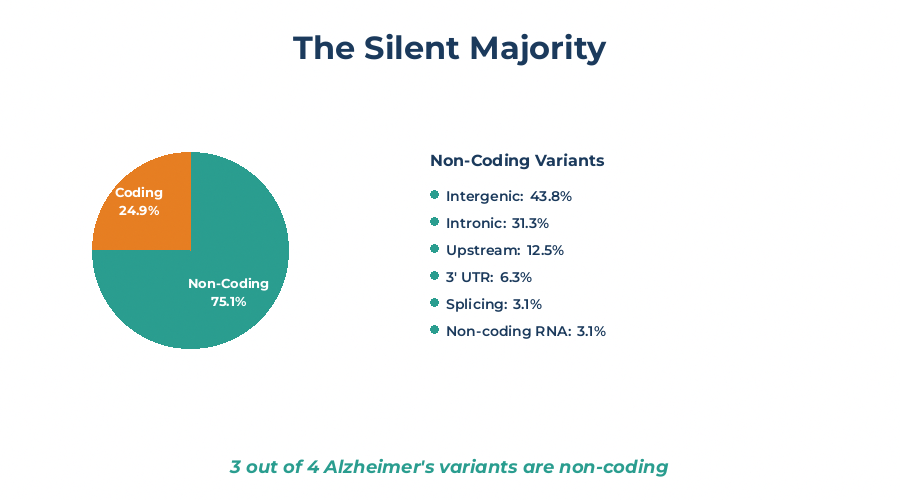
And in our study, 75.1% of Alzheimer's-associated variants were in non-coding regions.
This is a huge discovery. And it changes how we think about Alzheimer's genetics.
What Are Non-Coding Variants?
| Region | What It Does |
|---|---|
| Coding | Contains instructions for making proteins |
| Non-coding | Regulates gene expression, controls when and where genes are turned on |
Non-coding regions are the control panel. Coding regions are the factory.
Types of Non-Coding Variants
| Type | What It Affects |
|---|---|
| Intergenic | Between genes |
| Intronic | Inside genes (but not coding) |
| Upstream | Before a gene starts |
| 3' UTR | After a gene ends |
| Splicing | Affects how RNA is processed |
| Non-coding RNA | Produces regulatory RNAs |
Our Findings
Variant Distribution
| Category | Percentage |
|---|---|
| Intergenic | 43.8% |
| Intronic | 31.3% |
| Upstream | 12.5% |
| 3' UTR | 6.3% |
| Splicing | 3.1% |
| Non-coding RNA | 3.1% |
Total Non-Coding
| Category | Percentage |
|---|---|
| Non-coding | 75.1% |
| Coding | 24.9% |
This means 3 out of 4 Alzheimer's-associated variants are in non-coding regions.
What Non-Coding Variants Do
1. Affect Gene Expression
| Mechanism | What It Does |
|---|---|
| Promoter variants | Affect transcription |
| Enhancer variants | Increase transcription |
| Silencer variants | Decrease transcription |
| Insulator variants | Block transcription |
2. Affect RNA Processing
| Mechanism | What It Does |
|---|---|
| Splicing variants | Affect which exons are included |
| Polyadenylation variants | Affect mRNA stability |
| RNA structure variants | Affect RNA function |
3. Affect Chromatin Structure
| Mechanism | What It Does |
|---|---|
| Chromatin accessibility | Affects which regions are accessible |
| Histone modification | Affects gene expression |
| DNA methylation | Affects gene expression |
Why This Matters
1. Regulatory Variation Is Important
| Observation | Implication |
|---|---|
| Most variants are non-coding | Regulatory variation is important |
| Gene expression is affected | Alzheimer's may be driven by expression changes |
| Tissue-specific effects | Variants may affect specific tissues |
2. Therapeutic Opportunities
| Opportunity | How It Could Work |
|---|---|
| Modulate gene expression | Target regulatory regions |
| Affect RNA processing | Target splicing |
| Modify chromatin | Target epigenetic modifications |
3. Research Implications
| Implication | Detail |
|---|---|
| Need for functional studies | Need to understand regulatory effects |
| Need for tissue-specific studies | Expression varies by tissue |
| Need for multi-omics integration | Combine genetics and transcriptomics |
Examples of Non-Coding Variants in Alzheimer's
APOE Region
| Variant | Region | Effect |
|---|---|---|
| rs429358 | Coding (APOE) | Changes protein |
| rs3178166 | Non-coding | Affects expression |
| rs111371860 | Non-coding | Affects regulation |
Even in the APOE region, non-coding variants are important.
TREM2
| Variant | Region | Effect |
|---|---|---|
| R47H | Coding | Changes protein |
| Other variants | Non-coding | Affect expression |
TREM2 has both coding and non-coding Alzheimer's-associated variants.
The Challenge of Non-Coding Variants
Why They're Harder to Study
| Challenge | Why It Matters |
|---|---|
| No protein product | Can't study protein function |
| Tissue-specific effects | Need to study the right tissue |
| Context-dependent | Effects may depend on cellular context |
| Integration needed | Need to integrate multiple data types |
How We Approached This
| Approach | How It Helped |
|---|---|
| CADD scores | Predicted variant impact |
| RegulomeDB | Regulatory potential |
| Chromatin states | Tissue-specific activity |
| eQTL analysis | Expression effects |
What We Still Don't Know
1. Which Non-Coding Variants Are Functional?
We've identified many non-coding variants. We don't know which are functional.
2. How Do They Work?
We need to understand the mechanisms by which non-coding variants affect Alzheimer's.
3. In Which Tissues?
Expression varies by tissue. We need to study the right tissues.
4. At What Stage?
Effects may vary by developmental stage or disease stage.
The Bottom Line
- 75.1% of Alzheimer's-associated variants are in non-coding regions
- Non-coding variants affect gene expression rather than protein structure
- Regulatory variation is important in Alzheimer's disease
- Non-coding variants are harder to study but may offer therapeutic opportunities
- More research is needed to understand non-coding variant function
The silent majority of Alzheimer's variants are non-coding—and they're finally getting the attention they deserve.
Key Takeaways
| Finding | Implication |
|---|---|
| 75.1% of variants = non-coding | Regulatory variation matters |
| Intergenic = 43.8% | Between genes |
| Intronic = 31.3% | Inside genes |
| Regulatory effects are key | Expression changes drive risk |
What do you think?
0 Responses
Osaghale L, Beshiru A, Subhan U. (2026). Replication-guided functional genomic prioritization of regulatory risk variants in Alzheimer's disease. Gene Reports. 44: 102551.
Code Availability: https://github.com/Oselin1988/GWAS_AD
Next post: "FUMA: The Swiss Army Knife of Functional Annotation" — Coming soon!
← Back to Blog Home