📅 4 July 2026🏷️ Alzheimer's Genetics⏱️ 6 min read👩🔬 Linda Osaghale
The Tool That Helped Us Decode Alzheimer's Genetics
Imagine you've found a treasure map. But the map is written in code. You need a decoder ring to understand it.
That's what functional annotation tools are for genetic research. And FUMA is one of the best.
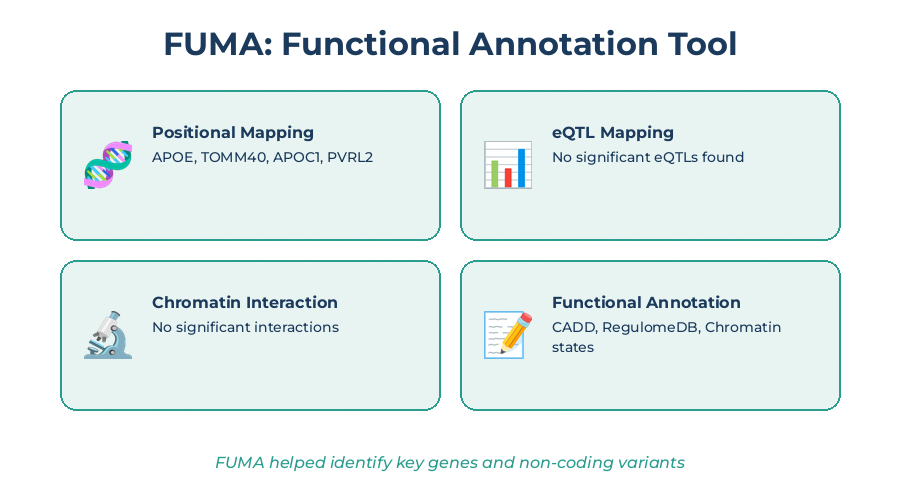
Figure 1: FUMA (Functional Mapping and Annotation of GWAS) is a comprehensive tool for annotating GWAS results, including positional mapping, eQTL analysis, chromatin interaction mapping, and functional annotation. Based on Osaghale et al. (2026).
What Is FUMA?
FUMA (Functional Mapping and Annotation of GWAS) is a comprehensive functional annotation tool:
Feature
What It Does
SNP2GENE
Annotates GWAS results
GENE2FUNC
Analyzes gene sets
Visualization
Generates plots and tables
Integration
Combines multiple data types
FUMA is your decoder ring for Alzheimer's genetics.
What FUMA Does
1. Positional Mapping
Function
What It Does
SNP proximity
Identifies genes near SNPs
Gene boundaries
Maps SNPs to genes
Distance threshold
Default ±10 kb
2. eQTL Mapping
Function
What It Does
Expression effects
Identifies SNPs that affect expression
Tissue specificity
Identifies tissue-specific effects
GTEx data
Uses GTEx v8 data
3. Chromatin Interaction Mapping
Function
What It Does
3D structure
Identifies chromatin interactions
Hi-C data
Uses H1-hESC and IMR90 cell lines
Regulatory elements
Identifies enhancer-promoter interactions
4. Functional Annotation
Function
What It Does
CADD scores
Predicts variant impact
RegulomeDB
Regulatory potential
Chromatin states
Tissue-specific activity
How We Used FUMA
Step 1: Input
We provided:
Input
What It Was
GWAS summary statistics
FinnGen Alzheimer's data
Lead SNPs
Three genome-wide significant variants
LD reference
1000 Genomes Phase 3 European
Step 2: Annotation
FUMA performed:
Annotation
What It Found
Positional mapping
APOE, TOMM40, APOC1, PVRL2
eQTL mapping
No significant eQTLs
Chromatin interaction
No significant interactions
Functional annotation
CADD scores, RegulomeDB, chromatin states
Step 3: Output
FUMA generated:
Output
What It Showed
Gene prioritization
APOE, TOMM40, APOC1, PVRL2
Variant annotation
75.1% non-coding
Regional plots
Chromosome 19 locus
LD structure
r² ≥ 0.6 with lead SNP
What FUMA Revealed
1. APOE, TOMM40, APOC1, and PVRL2
Gene
Function
Significance
APOE
Lipid transport, amyloid clearance
Lead gene
TOMM40
Mitochondrial function
Equivalent to APOE
APOC1
Lipid metabolism
Equivalent to APOE
PVRL2
Cell adhesion
Lower but significant
The chromosome 19 locus contains multiple genes, not just APOE.
2. Non-Coding Variants
Category
Percentage
Intergenic
43.8%
Intronic
31.3%
Total non-coding
75.1%
Most variants are in non-coding regions.
3. LD Structure
Observation
Implication
r² ≥ 0.6 with lead SNP
Multiple variants are correlated
Shared haplotype
Variants are inherited together
Gene-rich interval
Multiple genes in the locus
What We Did NOT Find
No Significant eQTLs
Finding
Implication
No eQTL evidence
Variants don't show clear expression effects
Maybe context-dependent
Effects may depend on cell type or state
Need experimental validation
Functional studies needed
No Significant Chromatin Interactions
Finding
Implication
No chromatin interaction evidence
Variants don't show clear 3D interactions
Maybe context-dependent
Interactions may depend on cell type
Need experimental validation
3D studies needed
The Limitations of FUMA
1. Context Dependence
Limitation
Why It Matters
Tissue-specific
Effects may only appear in certain tissues
Cell-state dependent
Effects may depend on cellular state
Dynamic
Effects may change over time
2. Data Quality
Limitation
Why It Matters
Reference data
Depends on quality of reference datasets
Sample size
Limited by available data
Ancestry
Reference data is mostly European
3. Prediction vs. Reality
Limitation
Why It Matters
Predictions
FUMA makes predictions, not measurements
Experimental validation needed
Predictions need confirmation
False positives
Some predictions may be wrong
The Bottom Line
FUMA is a powerful functional annotation tool
It identified APOE, TOMM40, APOC1, and PVRL2 as key genes
Most variants are non-coding (75.1%)
No significant eQTLs or chromatin interactions were found
Experimental validation is needed for functional confirmation
FUMA helped us understand our Alzheimer's genetics—but it's just the beginning.