
Understanding the Most Powerful Genetic Risk Factor for Alzheimer's Disease
If you've read anything about Alzheimer's disease genetics, you've probably heard of APOE. But why does this one gene get so much attention? And what does it actually do?
In our study, the APOE locus emerged as the dominant genetic risk factor for Alzheimer's disease. But there's more to this story than just one gene.
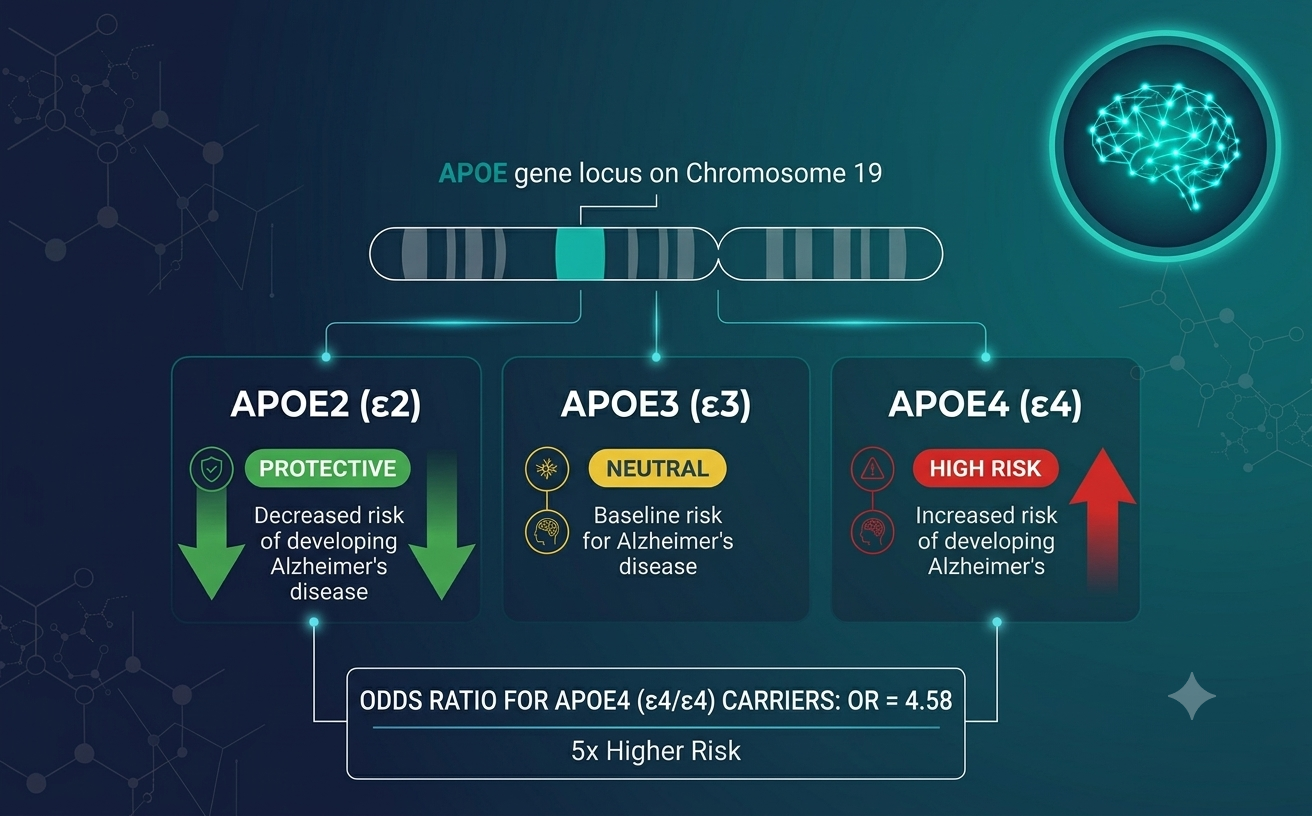
What Is APOE?
APOE (apolipoprotein E) is a gene that provides instructions for making a protein involved in:
- Lipid transport: Moving fats and cholesterol around the body
- Brain function: Supporting neuronal health and repair
- Immune response: Modulating inflammation
- Amyloid clearance: Removing harmful protein aggregates
The Three Common Variants
APOE exists in three common forms (alleles):
| Variant | Risk | Population Frequency |
|---|---|---|
| APOE2 | Protective | ~8% |
| APOE3 | Neutral | ~78% |
| APOE4 | Risk-increasing | ~14% |
APOE4 is the strongest genetic risk factor for Alzheimer's disease. Having one copy increases risk by 3-fold. Having two copies increases risk by up to 15-fold.
What We Found
Our study identified three genome-wide significant variants, all within the APOE region:
Lead Variant 1: rs429358
This is the variant that defines the APOE4 allele.
| Characteristic | Value |
|---|---|
| Chromosome | 19 |
| Position | 45,411,941 |
| Effect Allele | C |
| Odds Ratio | 4.58 |
| 95% CI | 4.15 – 5.06 |
| P-value | 5.20 × 10⁻¹⁹⁷ |
Interpretation: Carriers have nearly 5 times the risk of developing Alzheimer's disease. This is an enormous effect size for a common genetic variant.
Lead Variant 2: rs3178166
| Characteristic | Value |
|---|---|
| Chromosome | 19 |
| Position | 45,594,170 |
| Effect Allele | G |
| Odds Ratio | 0.80 |
| 95% CI | 0.75 – 0.85 |
| P-value | 1.53 × 10⁻¹¹ |
Interpretation: This variant is protective. Carriers have approximately 20% lower risk of Alzheimer's disease.
Lead Variant 3: rs111371860
| Characteristic | Value |
|---|---|
| Chromosome | 19 |
| Position | 45,345,787 |
| Effect Allele | T |
| Odds Ratio | 1.44 |
| 95% CI | 1.29 – 1.62 |
| P-value | 3.91 × 10⁻¹⁰ |
Interpretation: Carriers have approximately 44% higher risk of Alzheimer's disease.
But APOE Doesn't Act Alone
The APOE region on chromosome 19 is a genetic neighbourhood with multiple genes:
| Gene | Function | Connection to Alzheimer's |
|---|---|---|
| APOE | Lipid transport | Main risk gene |
| TOMM40 | Mitochondrial protein import | May affect mitochondrial function and energy metabolism |
| APOC1 | Lipid metabolism | May influence cholesterol transport and Alzheimer's risk |
| PVRL2 | Cell adhesion | May affect neuronal connectivity and synaptic function |
These genes are in strong linkage disequilibrium (LD), meaning they're often inherited together. This makes it challenging to determine which variant is truly causal versus which is simply "tagging along."
What About APOE2 and APOE3?
While our study focused on the APOE4 risk allele, the APOE2 and APOE3 variants are equally important:
| Variant | Effect | Mechanism |
|---|---|---|
| APOE2 | Protective | Better lipid transport, more efficient amyloid clearance |
| APOE3 | Neutral | Normal function |
| APOE4 | Risk-increasing | Impaired lipid transport, reduced amyloid clearance, increased inflammation |
Why APOE4 is Harmful
- Impaired lipid transport: APOE4 is less efficient at moving lipids
- Reduced amyloid clearance: APOE4 doesn't clear amyloid-beta as well
- Increased inflammation: APOE4 promotes pro-inflammatory responses
- Mitochondrial dysfunction: APOE4 affects energy metabolism
- mTOR hyperactivation: APOE4 impairs cellular cleanup (autophagy)
The APOE and mTOR Connection
One of the most exciting findings from our study is the connection between APOE and the mTOR pathway.
What is mTOR?
mTOR (mechanistic target of rapamycin) is a master regulator of cellular metabolism, autophagy, and neuronal function.
The APOE4-mTOR connection:
- APOE4 activates mTORC1 (mTOR complex 1)
- mTORC1 activation suppresses autophagy
- Suppressed autophagy leads to accumulation of damaged proteins and organelles
- This contributes to neurodegeneration
Why this matters for therapy:
- mTOR inhibitors (e.g., rapamycin) could restore autophagy
- They could reduce inflammation in APOE4 carriers
- They are already being investigated in clinical trials for neurodegenerative diseases
The APOE Locus: A Complex Genetic Landscape
Our regional association analysis revealed that the APOE locus spans approximately 250 kb and includes:
- ~17 SNPs mapped to the locus
- ~14 genes physically located within the locus boundaries
- Multiple variants in high LD (r² ≥ 0.6) with the lead SNP
Visualizing the Locus:
The chromosome 19 locus (19:45,345,787 – 45,602,781) contains:
APOE → TOMM40 → APOC1 → APOC4 → PVRL2
   ↑        ↑        ↑        ↑
   Strong linkage disequilibrium
This LD structure means that multiple variants and genes are inherited together, making it difficult to pinpoint the exact causal variant.
What This Means for Alzheimer's Risk Prediction
APOE genotyping is the most informative single genetic test for Alzheimer's disease.
However, our study showed that:
- APOE contributes 71.1% of genome-wide significant risk
- Non-APOE genes contribute 28.9% of risk
- A complete risk assessment should consider both APOE and non-APOE variants
Clinical Implications
| Scenario | Recommendation |
|---|---|
| APOE4 carrier | Consider early screening, lifestyle interventions |
| APOE2 carrier | Reassurance, but continue monitoring |
| APOE4/APOE4 | Highest risk, consider clinical trial participation |
| APOE3/APOE3 | Average risk, standard recommendations |
The Bottom Line
- APOE is the dominant genetic risk factor for Alzheimer's disease
- rs429358 (APOE4) increases risk nearly 5-fold
- The APOE locus is complex with multiple genes and variants
- APOE4 affects multiple pathways: Lipid transport, amyloid clearance, inflammation, mTOR signaling
- Non-APOE genes also contribute to Alzheimer's risk
Understanding APOE is essential for Alzheimer's research, prevention, and treatment.
Key Takeaways
| Finding | Implication |
|---|---|
| rs429358 (APOE4) OR = 4.58 | Nearly 5x higher risk |
| rs3178166 OR = 0.80 | 20% lower risk (protective) |
| rs111371860 OR = 1.44 | 44% higher risk |
| APOE contributes 71.1% of risk | Dominant genetic factor |
| Non-APOE contributes 28.9% | Still important |
What do you think?
0 Responses
Osaghale L, Beshiru A, Subhan U. (2026). Replication-guided functional genomic prioritization of regulatory risk variants in Alzheimer's disease. Gene Reports. 44: 102551.
Next post: "The $64,000 Question: What If We're Missing Half the Alzheimer's Story?" — Coming soon!
← Back to Blog Home