📅 1 July 2026🏷️ Alzheimer's Genetics⏱️ 6 min read👩🔬 Linda Osaghale
Why Distant Genes Can Affect Alzheimer's Disease
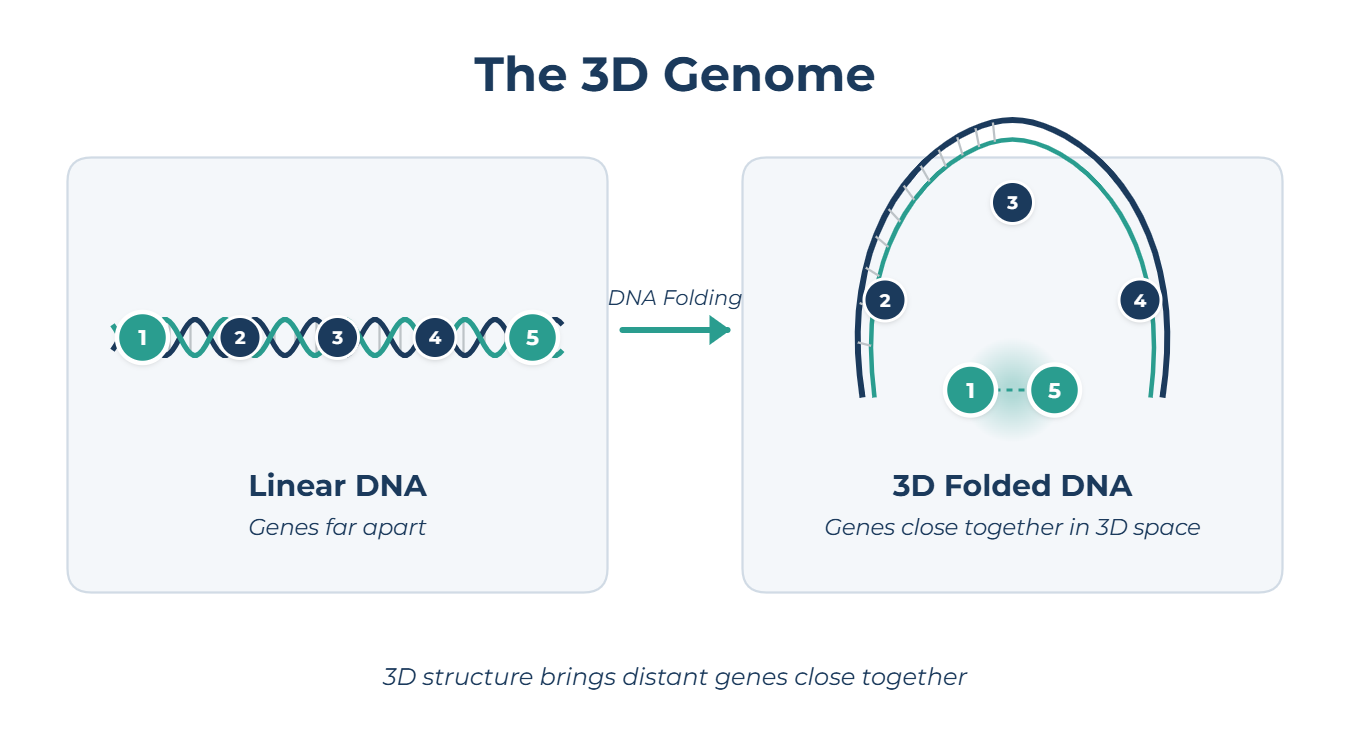
Imagine your DNA as a jumbled ball of string. Genes that are far apart on the string can be close together in the ball.
That's the 3D genome. And it matters for Alzheimer's disease.
Figure 1: The 3D genome folds DNA into loops, bringing enhancers and promoters together. Our study found no significant chromatin interactions for Alzheimer's lead variants. Based on Osaghale et al. (2026).
What Is 3D Genome Structure?
Feature
What It Means
Linear genome
DNA sequence in order
3D genome
How DNA is folded in 3D space
Chromatin interactions
Contacts between distant DNA regions
The 3D genome brings distant genes close together.
Why 3D Structure Matters
1. Enhancer-Promoter Interactions
Observation
Implication
Enhancers and promoters
Need to be close
3D contacts
Bring them together
Regulation
Controls gene expression
2. Gene Regulation
Observation
Implication
Distant elements
Can affect gene expression
3D structure
Determines which elements interact
Tissue specificity
Structure varies by tissue
3. Disease Relevance
Observation
Implication
Altered structure
Changes in 3D structure can cause disease
Risk variants
Variants may affect 3D structure
Therapeutic targets
3D structure could be targeted
How We Assessed 3D Structure
Data Used
Data
What It Provided
Hi-C data
Chromatin interactions
H1-hESC
Embryonic stem cells
IMR90
Fibroblasts
Our Approach
Step
What We Did
1
Identified lead variants
2
Extracted chromatin interaction data
3
Tested for significant interactions
4
Interpreted relevance
What We Found
No Significant Chromatin Interactions
Finding
Detail
ciMapFilt = 0
No significant chromatin interactions
No 3D contacts
Variants don't show clear 3D interactions
Limited data
Only two cell lines available
What This Means
Implication
Detail
No detectable 3D effects
At least not in tested cells
Context dependence
Interactions may depend on cell type
Need more data
More cell lines needed
Why We Didn't Find 3D Interactions
1. Cell Type Specificity
Reason
Explanation
Wrong cell type
Interactions may be in other cell types
Neuronal interactions
Need neuronal Hi-C data
Microglial interactions
Need microglial Hi-C data
2. Context Dependence
Reason
Explanation
Disease state
Interactions may only appear in Alzheimer's brains
Cellular state
Interactions may depend on cellular state
Environmental factors
Interactions may depend on environmental stimuli
3. Technical Limitations
Reason
Explanation
Limited data
Few cell lines available
Resolution
Hi-C data may not have sufficient resolution
Methodology
Detection methods may miss some interactions
What This Tells Us
1. 3D Structure Is Complex
Observation
Implication
No clear interactions
3D structure is context-dependent
Need more data
More cell lines and conditions needed
Integration needed
Combine with other data types
2. Alternative Mechanisms
Mechanism
What It Affects
Protein function
Protein activity
Gene expression
RNA levels
Chromatin state
DNA accessibility
3. Need for Multi-Omic Integration
Approach
What It Provides
Genomics
DNA variants
Transcriptomics
RNA expression
Epigenomics
DNA methylation
3D genomics
Chromatin interactions
The Bottom Line
We found no significant chromatin interactions for our lead variants
This may be due to context dependence or technical limitations
More cell lines and conditions are needed
3D structure is complex and context-dependent
Integration with other data is essential
The 3D genome is important—but we need more data to understand it fully.