
The One Science Lesson That Could Save Your Life
There's a saying in science: "Extraordinary claims require extraordinary evidence."
There's another saying: "One study doesn't prove anything."
These aren't just cute phrases. They're the foundation of how science actually works. And in Alzheimer's genetic research, they're more important than ever.
The Replication Crisis
You've probably heard about the "replication crisis" in science. It goes something like this:
- A study finds something exciting
- It makes headlines
- Everyone gets excited
- Other scientists try to replicate it
- They can't
- The original finding is questioned
- Everyone moves on to the next exciting finding
This happens more often than you'd think—and it happens in Alzheimer's research too.
Why Doesn't Replication Always Work?
| Reason | Explanation |
|---|---|
| Small sample sizes | Small studies often find spurious results |
| Population differences | What's true in one population may not be true in another |
| Phenotype differences | Different definitions of Alzheimer's produce different results |
| Statistical noise | Sometimes you find associations by chance |
| Publication bias | Positive results get published; negative results don't |
What We Did: Replication-First
In our study, we made replication a priority. Here's our philosophy:
Before you interpret, confirm. Before you publish, replicate.
Step 1: Discovery
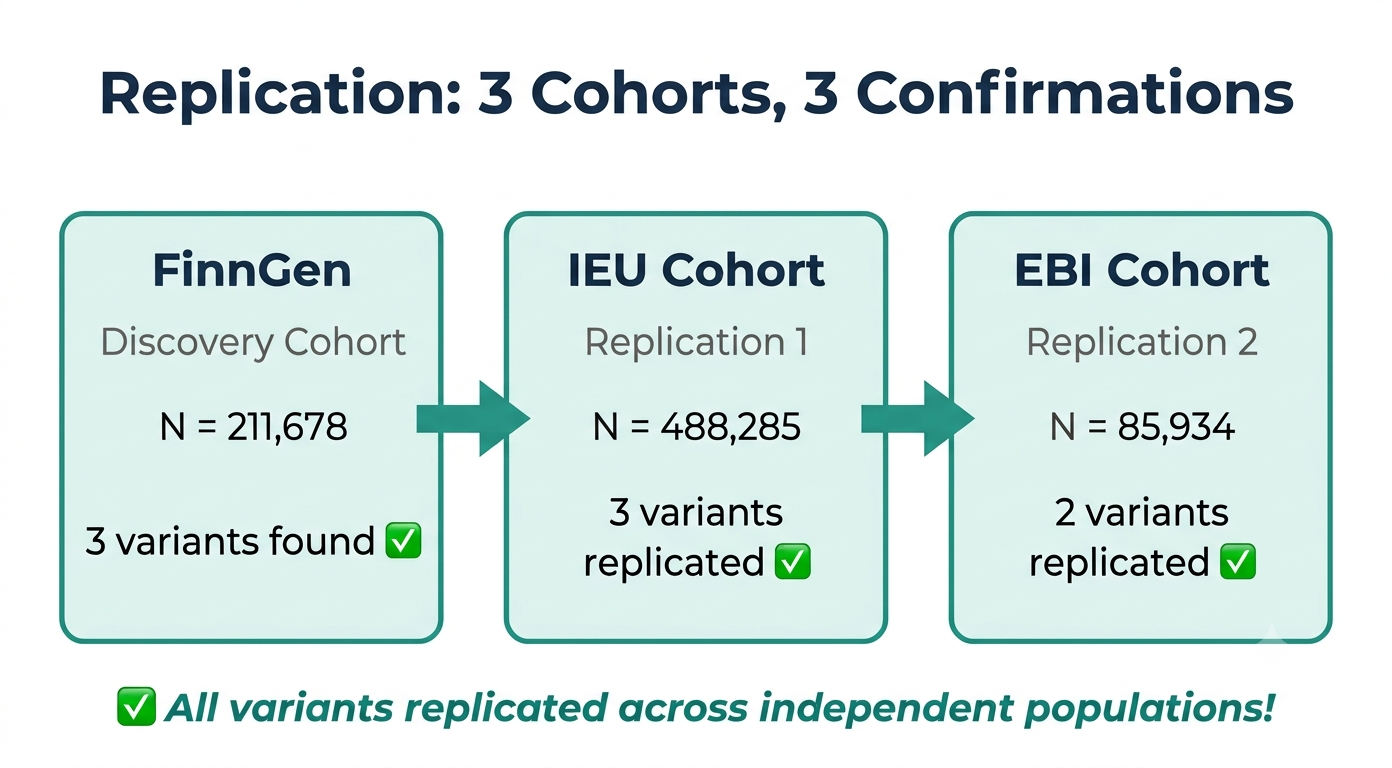
We found three lead variants in the FinnGen cohort.
Step 2: Replication
We tested them in two independent cohorts.
Step 3: Confirmation
We applied strict criteria:
- Same effect direction
- Statistical significance after Bonferroni correction (P < 0.0167)
- Consistent across cohorts
Our Replication Results
Replication Cohort 1: IEU (N = 488,285)
| Variant | Discovery P | Replication P | Replicated? |
|---|---|---|---|
| rs429358 | 5.20 × 10⁻¹⁹⁷ | 2.80 × 10⁻¹⁷⁵ | ✅ YES |
| rs3178166 | 1.53 × 10⁻¹¹ | 3.90 × 10⁻³ | ✅ YES |
| rs111371860 | 3.91 × 10⁻¹⁰ | 4.30 × 10⁻⁹ | ✅ YES |
All three variants replicated successfully.
Replication Cohort 2: EBI (N = 85,934)
| Variant | Discovery P | Replication P | Replicated? |
|---|---|---|---|
| rs429358 | 5.20 × 10⁻¹⁹⁷ | Not available | N/A |
| rs3178166 | 1.53 × 10⁻¹¹ | 1.47 × 10⁻⁴ | ✅ YES |
| rs111371860 | 3.91 × 10⁻¹⁰ | 1.37 × 10⁻⁴⁶ | ✅ YES |
Two of three variants replicated successfully.
Why This Matters
1. Confidence
Replicated findings are more trustworthy.
When you see a finding replicated across multiple independent cohorts, you can be confident it's real—not a statistical fluke.
2. Generalizability
Replication in different populations shows generalizability.
Our findings replicated in the UK Biobank (IEU) and EBI cohorts. This suggests they're not just specific to Finnish people.
3. Resource Allocation
Replication prevents wasted resources.
If you spend years investigating a finding that doesn't replicate, you've wasted time, money, and effort. Replication-first saves resources.
4. Clinical Translation
Replicated findings are safer to translate into clinical use.
Would you want a genetic test based on a single study? Or one based on multiple replicated studies?
The Statistics of Replication
Why Bonferroni Correction?
When we replicated three variants, we needed to adjust for multiple testing:
Bonferroni threshold = 0.05 / 3 = 0.0167
This means our replication P-values had to be less than 0.0167 to be considered significant. All our variants met this threshold.
Why Effect Direction Matters
Replication requires:
- Same effect direction: The variant must increase or decrease risk in the same direction
- Statistical significance: The association must be significant after correction
- Consistency: The finding should be consistent across cohorts
What We Learned
Lesson 1: Replication Works
All our variants replicated in at least one independent cohort. Two of three replicated in both cohorts. This gives us confidence in our findings.
Lesson 2: Replication Reveals Nuance
The differences between cohorts taught us:
| Difference | Implication |
|---|---|
| Different effect sizes | Population-specific effects may exist |
| Different phenotype definitions | How you define Alzheimer's matters |
| Variant availability differences | Technical challenges exist, especially in APOE region |
Lesson 3: Replication Requires Transparency
We documented our methods carefully so others can replicate our work. This is how science progresses.
The Bottom Line
- Replication is essential for reliable genetic research
- All our variants replicated in independent cohorts
- Replication increases confidence in findings
- Replication reveals nuance across populations and study designs
- Transparent methods enable replication
One study doesn't prove anything. But multiple replicated studies? That's how we build knowledge.
Key Takeaways
| Principle | Why It Matters |
|---|---|
| Replicate before interpreting | Prevents false positives |
| Replicate across populations | Ensures generalizability |
| Apply strict statistical criteria | Reduces false positives |
| Document methods transparently | Enables replication |
What do you think?
0 Responses
Osaghale L, Beshiru A, Subhan U. (2026). Replication-guided functional genomic prioritization of regulatory risk variants in Alzheimer's disease. Gene Reports. 44: 102551.
Code Availability: https://github.com/Oselin1988/GWAS_AD
Next post: "FinnGen: The Finnish Study That Changed Everything" — Coming soon!
← Back to Blog Home