
How One Country's Unique Genetics Revolutionized Alzheimer's Research
Finland is a country of 5.5 million people. It's known for saunas, reindeer, and surprisingly good education. But it's also home to one of the most powerful genetic research resources in the world: the FinnGen study.
In our Alzheimer's research, FinnGen was the foundation—the discovery cohort that started everything. But why Finland? And what makes FinnGen so special?
What Is FinnGen?
FinnGen is a large-scale genomic research project that combines:
- Genetic data from Finnish biobanks
- Health records from Finnish healthcare systems
- Population structure from a relatively isolated population
Key Facts
| Characteristic | Detail |
|---|---|
| Started | 2017 |
| Participants | 500,000+ |
| Biobanks | Multiple Finnish biobanks |
| Health data | Comprehensive EHRs |
| Population | Finnish (European ancestry) |
FinnGen is one of the largest population-based genomics projects in the world.
Why Finland?
Finland has several unique characteristics that make it ideal for genetic research:
1. Founder Effect
Finland was settled by a relatively small group of people. This means:
- Limited genetic diversity: Fewer founder populations
- More homogeneous population: Reduced population stratification
- Clearer genetic signals: Easier to detect associations
2. Isolated Population
Finland's geographic isolation means:
- Limited gene flow: Less mixing with other populations
- More recent founder effects: Genetic variants are more recent
- Distinct genetic architecture: Some variants are unique to Finns
3. Comprehensive Health Records
Finland has:
- Universal healthcare: Everyone has health records
- Longitudinal data: Records going back decades
- Linked data: Genetic and health data can be linked
4. High Quality of Life
Finns are generally healthy and well-educated, which means:
- Good health data: Accurate diagnoses
- Low dropout rates: People stay in studies
- High compliance: People participate in research
Our FinnGen Dataset
We used data from the FinnGen Alzheimer's disease endpoint:
Study ID: finn-b-F5_ALZHEMENT
| Characteristic | Detail |
|---|---|
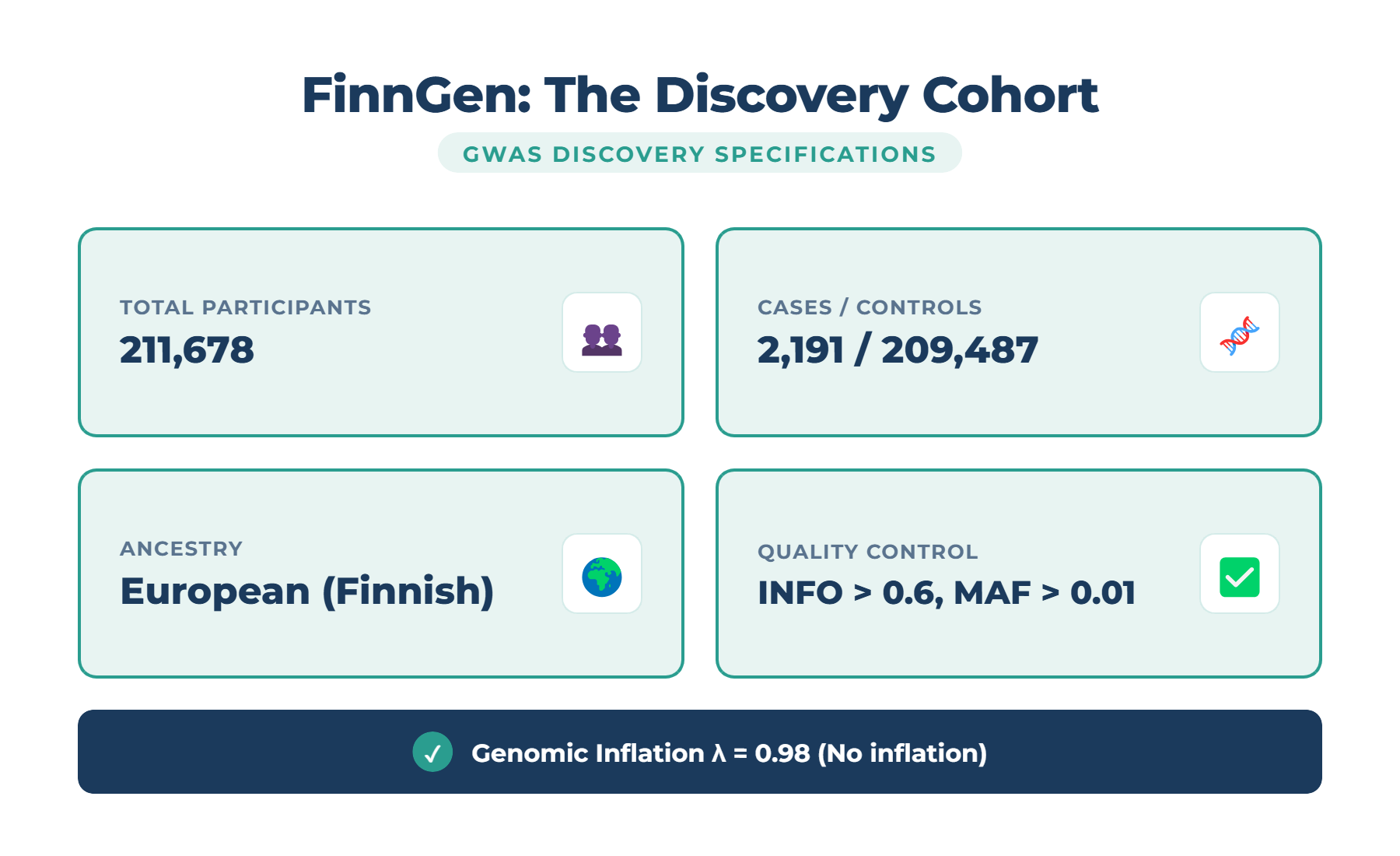
| Total N | 211,678 |
| Cases | 2,191 (clinically-defined) |
| Controls | 209,487 |
| Ancestry | European (Finnish) |
| Genotyping | Illumina and Affymetrix arrays |
| Imputation | SISu v3 reference panel (Finnish-specific) |
Why We Chose This Dataset
- Large sample size: 211,678 individuals
- Clinically-defined cases: Accurate diagnosis
- Comprehensive data: Full summary statistics available
- European ancestry: Compatible with replication cohorts
- Quality control: INFO > 0.6, MAF > 0.01
Quality Control in FinnGen
Genomic Inflation (λ = 0.98)
Genomic inflation measures whether the test statistic distribution is inflated due to population stratification or technical artifacts.
| λ Value | Interpretation |
|---|---|
| λ = 1 | No inflation (ideal) |
| λ > 1 | Some inflation |
| λ > 1.1 | Significant inflation |
Our λ = 0.98, which means:
- ✅ No significant inflation
- ✅ Results aren't driven by population stratification
- ✅ Findings are reliable
Imputation Quality (INFO > 0.6)
Imputation predicts ungenotyped variants based on reference panels.
- ✅ Variants with INFO < 0.6 were excluded
- ✅ This ensures only high-quality imputed variants are included
Minor Allele Frequency (MAF > 0.01)
- ✅ Variants with MAF < 0.01 were excluded
- ✅ This ensures only common variants are included
- ✅ Reduces the risk of spurious associations
What Made This Discovery Successful?
1. Large Sample Size
With 211,678 individuals, we had:
- Sufficient statistical power to detect associations
- Ability to detect even modest effect sizes
- Reduced risk of false positives
2. Clinical Phenotype
Cases were clinically-defined Alzheimer's disease:
- ✅ Accurate diagnosis
- ✅ Consistent phenotype
- ✅ Reduced misclassification
3. Quality Control
Strict quality control:
- ✅ Reduced false positives
- ✅ Increased confidence in findings
- ✅ Facilitated replication
4. Open Data
The data were publicly available:
- ✅ Transparent research
- ✅ Reproducible findings
- ✅ Accessible to other researchers
Limitations of FinnGen
1. European Ancestry Only
FinnGen includes only European ancestry individuals:
- ⚠️ Findings may not generalize to non-European populations
- ⚠️ Population-specific effects may be missed
- ⚠️ Diversity in genetics is limited
2. Finnish Population Specificity
Finns have unique genetic characteristics:
- ⚠️ Some variants are specific to Finns
- ⚠️ Effect sizes may differ in other populations
- ⚠️ Replication in diverse populations is essential
3. Case-Control Ratio
The study had relatively few cases (2,191) compared to controls (209,487):
- ⚠️ Power was driven by controls
- ⚠️ More cases would increase power for some analyses
The Bottom Line
- FinnGen is a powerful resource for Alzheimer's genetics
- Finland's unique population structure makes it ideal for genetic research
- Our discovery dataset was high-quality with good sample size and clinical phenotype
- Quality control was strict to ensure reliable findings
- Limitations include European ancestry focus and Finnish population specificity
FinnGen gave us the foundation for discovery. But we didn't stop there. We replicated our findings in independent cohorts to ensure they were real.
Key Takeaways
| Aspect | Finding |
|---|---|
| Sample Size | 211,678 individuals |
| Cases | 2,191 clinically-defined |
| Controls | 209,487 |
| Ancestry | European (Finnish) |
| Genomic Inflation | λ = 0.98 (no inflation) |
| Quality Control | INFO > 0.6, MAF > 0.01 |
What do you think?
0 Responses
Osaghale L, Beshiru A, Subhan U. (2026). Replication-guided functional genomic prioritization of regulatory risk variants in Alzheimer's disease. Gene Reports. 44: 102551.
Code Availability: https://github.com/Oselin1988/GWAS_AD
Next post: "Meet the Three Variants That Could Change Your Risk of Alzheimer's" — Coming soon!
← Back to Blog Home