rs429358, rs3178166, and rs111371860 Explained
In our study, three genetic variants stood out from the rest. They were genome-wide significant, replicated across independent cohorts, and had powerful effects on Alzheimer's disease risk.
But what are these variants? What do they do? And what do they mean for you?
Let's meet them.
Variant 1: rs429358 (The APOE4 Variant)
The Star of the Show
| Characteristic | Detail |
|---|---|
| Chromosome | 19 |
| Position | 45,411,941 |
| Effect Allele | C |
| Other Allele | T |
| Effect Allele Frequency | 0.1802 |
| Beta | 1.5224 |
| SE | 0.0508 |
| Odds Ratio | 4.58 |
| 95% CI | 4.15 – 5.06 |
| P-value | 5.20 × 10⁻¹⁹⁷ |
What This Means
| Metric | Interpretation |
|---|---|
| OR = 4.58 | Carriers have nearly 5 times higher risk of Alzheimer's |
| P = 5.20 × 10⁻¹⁹⁷ | This association is as real as it gets |
| Effect allele = C | This is the "risk" allele |
| EAF = 18.02% | About 18% of the population carries this variant |
How It Works
rs429358 is the variant that defines the APOE4 allele. It causes a change in the APOE protein that:
- Impairs lipid transport: APOE4 is less efficient at moving lipids
- Reduces amyloid clearance: APOE4 doesn't clear amyloid-beta as well
- Increases inflammation: APOE4 promotes pro-inflammatory responses
- Affects mitochondrial function: APOE4 impairs energy metabolism
- Hyperactivates mTOR: APOE4 suppresses autophagy
Who Carries It?
| Genotype | Risk | Frequency |
|---|---|---|
| No APOE4 (ε3/ε3) | Baseline | ~60% |
| One APOE4 (ε3/ε4) | 3x higher | ~25% |
| Two APOE4 (ε4/ε4) | 15x higher | ~2-3% |
Variant 2: rs3178166 (The Protective Variant)
The Unexpected Hero
| Characteristic | Detail |
|---|---|
| Chromosome | 19 |
| Position | 45,594,170 |
| Effect Allele | G |
| Other Allele | A |
| Effect Allele Frequency | 0.4949 |
| Beta | -0.2229 |
| SE | 0.0330 |
| Odds Ratio | 0.80 |
| 95% CI | 0.75 – 0.85 |
| P-value | 1.53 × 10⁻¹¹ |
What This Means
| Metric | Interpretation |
|---|---|
| OR = 0.80 | Carriers have 20% lower risk of Alzheimer's |
| P = 1.53 × 10⁻¹¹ | Highly significant association |
| Effect allele = G | This is the "protective" allele |
| EAF = 49.49% | About half the population carries this variant |
How It Works
rs3178166 is located near the APOC1 gene, which is involved in lipid metabolism. The protective effect may work through:
- Improved lipid transport: Better movement of cholesterol and other lipids
- Reduced inflammation: Lower inflammatory responses
- Enhanced amyloid clearance: Better removal of amyloid-beta
- Improved mitochondrial function: Better energy metabolism
Why This Matters
If half the population carries a protective variant, this has huge public health implications. Even small protective effects at the individual level can have large population-level impacts.
Variant 3: rs111371860 (The Risk Variant)
The Hidden Danger
| Characteristic | Detail |
|---|---|
| Chromosome | 19 |
| Position | 45,345,787 |
| Effect Allele | T |
| Other Allele | A |
| Effect Allele Frequency | 0.0976 |
| Beta | 0.3660 |
| SE | 0.0585 |
| Odds Ratio | 1.44 |
| 95% CI | 1.29 – 1.62 |
| P-value | 3.91 × 10⁻¹⁰ |
What This Means
| Metric | Interpretation |
|---|---|
| OR = 1.44 | Carriers have 44% higher risk of Alzheimer's |
| P = 3.91 × 10⁻¹⁰ | Very strong association |
| Effect allele = T | This is the "risk" allele |
| EAF = 9.76% | About 10% of the population carries this variant |
How It Works
rs111371860 is located near the PVRL2 gene, which is involved in cell adhesion. The risk effect may work through:
- Impaired cell adhesion: Affects neuronal connectivity
- Synaptic dysfunction: Impairs communication between neurons
- Inflammatory responses: May promote neuroinflammation
Why This Matters
Although the effect is smaller than rs429358, 1.44x risk is still significant. With 10% of the population carrying this variant, many people are affected.
The Big Picture: All Three Variants
Chromosome 19 Locus
All three variants are located on chromosome 19, within a region of strong linkage disequilibrium (LD).
Chromosome 19: 45,345,787 - 45,602,781
[----------------------------------------]
    ↑                  ↑                ↑
rs111371860      rs429358        rs3178166
(44% ↑ risk)    (4.58x ↑ risk)  (20% ↓ risk)
This means these variants are inherited together. People who carry the risk alleles often carry multiple risk variants.
Combined Effects
| Scenario | Risk |
|---|---|
| No risk alleles | Baseline |
| rs111371860 only | 1.44x higher |
| rs429358 only | 4.58x higher |
| rs429358 + rs111371860 | ~6.6x higher |
| rs429358 + rs3178166 (protective) | ~3.7x higher |
| All three (2 risk, 1 protective) | ~5.3x higher |
The protective variant rs3178166 can partially offset the risk from APOE4.
What This Means for You
Genetic Testing
| Scenario | Recommendation |
|---|---|
| APOE4 carrier | Consider early screening, lifestyle interventions |
| APOE4 + rs111371860 | Higher risk, consider clinical trial participation |
| rs3178166 carrier | Some protection, continue standard recommendations |
| No risk variants | Average risk, standard recommendations |
Clinical Implications
- APOE genotyping is the most informative single test
- Combined risk assessment is more informative than APOE alone
- Protective variants matter and should be considered
- Non-APOE variants contribute to overall risk
The Bottom Line
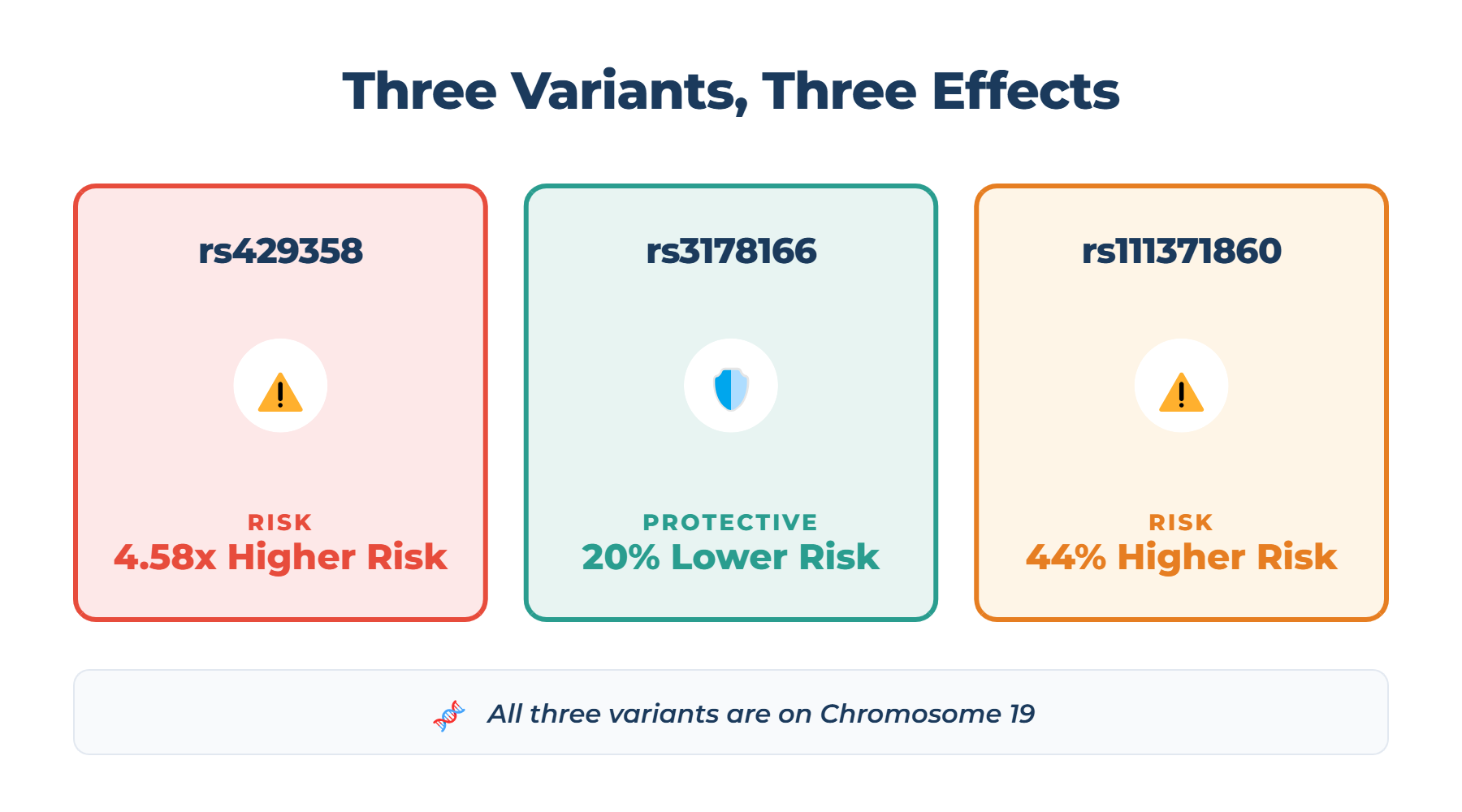
- rs429358 (APOE4): 4.58x higher risk (the powerhouse)
- rs3178166: 20% lower risk (the protective variant)
- rs111371860: 44% higher risk (the hidden danger)
Together, these variants paint a complex picture of Alzheimer's risk. And they're all on chromosome 19.
Key Takeaways
| Variant | Effect | Risk |
|---|---|---|
| rs429358 | Risk-increasing | 4.58x higher |
| rs3178166 | Protective | 20% lower |
| rs111371860 | Risk-increasing | 44% higher |
What do you think?
0 Responses
Osaghale L, Beshiru A, Subhan U. (2026). Replication-guided functional genomic prioritization of regulatory risk variants in Alzheimer's disease. Gene Reports. 44: 102551.
Code Availability: https://github.com/Oselin1988/GWAS_AD
Next post: "The mTOR Connection: How Cellular Metabolism Could Hold the Key to Alzheimer's" — Coming soon!
← Back to Blog Home