
The Hidden Link Between APOE, Cellular Cleanup, and Brain Health
Imagine your cells as tiny cities. They need energy. They need to get rid of trash. They need to communicate with each other. And when things go wrong, the whole system breaks down.
That's exactly what happens in Alzheimer's disease—and the mTOR pathway is right in the middle of it.
What Is mTOR?
mTOR (mechanistic target of rapamycin) is a protein that acts as a master regulator of cellular processes:
| Process | What It Does |
|---|---|
| Cell growth | Controls cell size and division |
| Metabolism | Regulates energy production and use |
| Autophagy | Controls cellular cleanup |
| Protein synthesis | Produces new proteins |
| Lipid synthesis | Produces fats and cholesterol |
| Neuronal function | Supports synaptic plasticity and memory |
mTOR is the conductor of the cellular orchestra.
The Two mTOR Complexes
mTOR forms two distinct complexes:
mTORC1
| Characteristic | Detail |
|---|---|
| Function | Promotes growth, suppresses autophagy |
| Sensitive to | Nutrients, growth factors, energy status |
| In Alzheimer's | Hyperactivated in APOE4 carriers |
mTORC2
| Characteristic | Detail |
|---|---|
| Function | Controls cell survival, cytoskeleton |
| Sensitive to | Growth factors |
| In Alzheimer's | Less well-studied |
The APOE4-mTOR Connection
What We Found
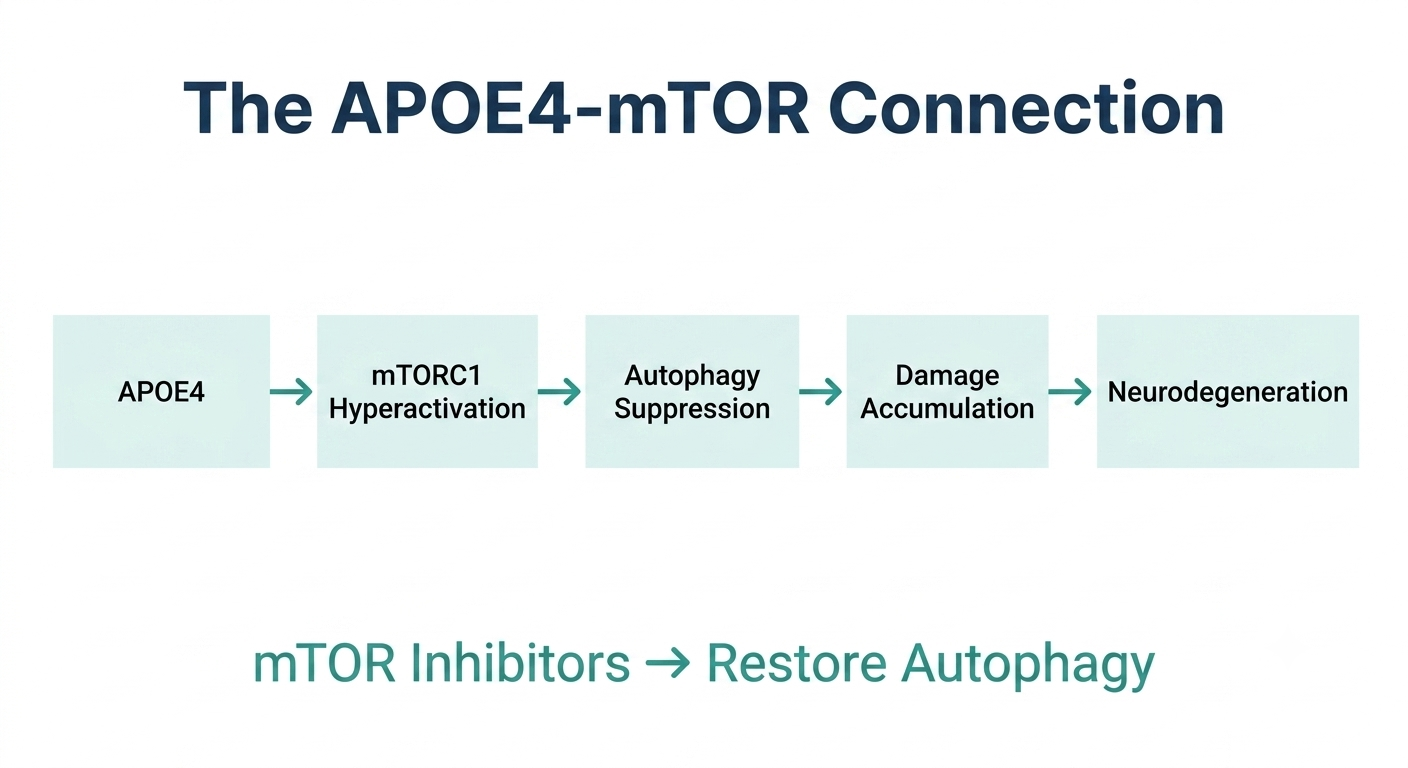
Our study highlighted the connection between APOE and mTOR signaling. Here's how it works:
Step 1: APOE4 Activates mTORC1
APOE4 leads to hyperactivation of mTORC1.
Step 2: mTORC1 Suppresses Autophagy
Autophagy is the cell's cleanup system. When mTORC1 is hyperactivated, autophagy is suppressed.
Step 3: Damage Accumulates
Without proper autophagy, damaged proteins and organelles accumulate.
Step 4: Neuronal Dysfunction
Accumulated damage leads to neuronal dysfunction and death.
The Vicious Cycle
APOE4 → mTORC1 hyperactivation → Autophagy suppression →
Damage accumulation → Neuronal dysfunction → Neurodegeneration
Why Autophagy Matters
Autophagy is the cell's recycling system:
| Function | What It Does |
|---|---|
| Protein clearance | Removes damaged proteins (including amyloid-beta and tau) |
| Organelle recycling | Removes damaged mitochondria and other organelles |
| Energy production | Provides nutrients during stress |
| Quality control | Maintains cellular health |
When autophagy fails, the cell fills with trash. This is a key feature of Alzheimer's disease.
The Evidence
Preclinical Studies
Studies in animal models show:
| Finding | Implication |
|---|---|
| mTOR inhibitors restore autophagy | Autophagy can be pharmacologically enhanced |
| mTOR inhibitors reduce amyloid pathology | Amyloid plaques are reduced |
| mTOR inhibitors reduce tau pathology | Tau tangles are reduced |
| mTOR inhibitors improve cognitive function | Behavioral improvements in animal models |
Human Studies
Human studies show:
| Finding | Implication |
|---|---|
| mTOR signaling is altered in Alzheimer's brains | mTOR dysregulation is present |
| Autophagy is impaired in Alzheimer's brains | Cellular cleanup fails |
| APOE4 carriers show mTOR dysregulation | APOE4 affects mTOR signaling |
The Therapeutic Opportunity
mTOR Inhibitors
| Drug | Type | Status |
|---|---|---|
| Rapamycin | mTOR inhibitor | Approved for other indications |
| Rapamycin analogs | mTOR inhibitors | Approved for other indications |
| Novel mTOR inhibitors | Newer molecules | In development |
How They Could Work
- Restore autophagy: Clear damaged proteins and organelles
- Reduce inflammation: Decrease pro-inflammatory responses
- Improve mitochondrial function: Enhance energy metabolism
- Preserve synaptic function: Protect neuronal connections
Challenges
| Challenge | Why It Matters |
|---|---|
| Systemic effects | mTOR is essential for many tissues |
| Side effects | Immunosuppression, metabolic changes |
| Targeting | Need brain-specific delivery |
| Timing | When to intervene? |
Why This Matters
1. New Therapeutic Targets
mTOR is a druggable target. Existing drugs (rapamycin and its analogs) are already approved for other indications. This could accelerate Alzheimer's drug development.
2. Personalized Medicine
APOE4 carriers might benefit most from mTOR-targeted therapies. This could enable personalized treatment approaches.
3. Prevention
mTOR-targeted therapies could potentially be used preventively in high-risk individuals.
4. Combination Approaches
mTOR inhibitors could be combined with other therapies to enhance effectiveness.
What We Still Don't Know
1. Optimal Timing
When should mTOR-targeted therapies be initiated? Early in the disease process? Or later?
2. Optimal Dose
What's the right dose? Too much mTOR inhibition could have side effects. Too little might not work.
3. Which Patients?
Which patients benefit most? APOE4 carriers? Others?
4. Combination Strategies
How should mTOR inhibitors be combined with other therapies? With amyloid-targeting drugs? With anti-inflammatory drugs?
The Bottom Line
- mTOR is a master regulator of cellular metabolism
- APOE4 activates mTORC1 and suppresses autophagy
- Autophagy failure leads to damage accumulation
- mTOR inhibitors could restore autophagy
- This represents a promising therapeutic strategy
Understanding the APOE4-mTOR connection could lead to new treatments for Alzheimer's disease.
Key Takeaways
| Concept | Implication |
|---|---|
| mTOR regulates autophagy | mTOR controls cellular cleanup |
| APOE4 activates mTOR | APOE4 suppresses autophagy |
| Autophagy failure causes damage | Damaged proteins and organelles accumulate |
| mTOR inhibitors restore autophagy | Potential therapeutic strategy |
What do you think?
0 Responses
Osaghale L, Beshiru A, Subhan U. (2026). Replication-guided functional genomic prioritization of regulatory risk variants in Alzheimer's disease. Gene Reports. 44: 102551.
Code Availability: https://github.com/Oselin1988/GWAS_AD
Next post: "Your Alzheimer's Risk Score: What 71.1% Really Means" — Coming soon!
← Back to Blog Home