
Why APOE Isn't the Whole Story (But It's Most of It)
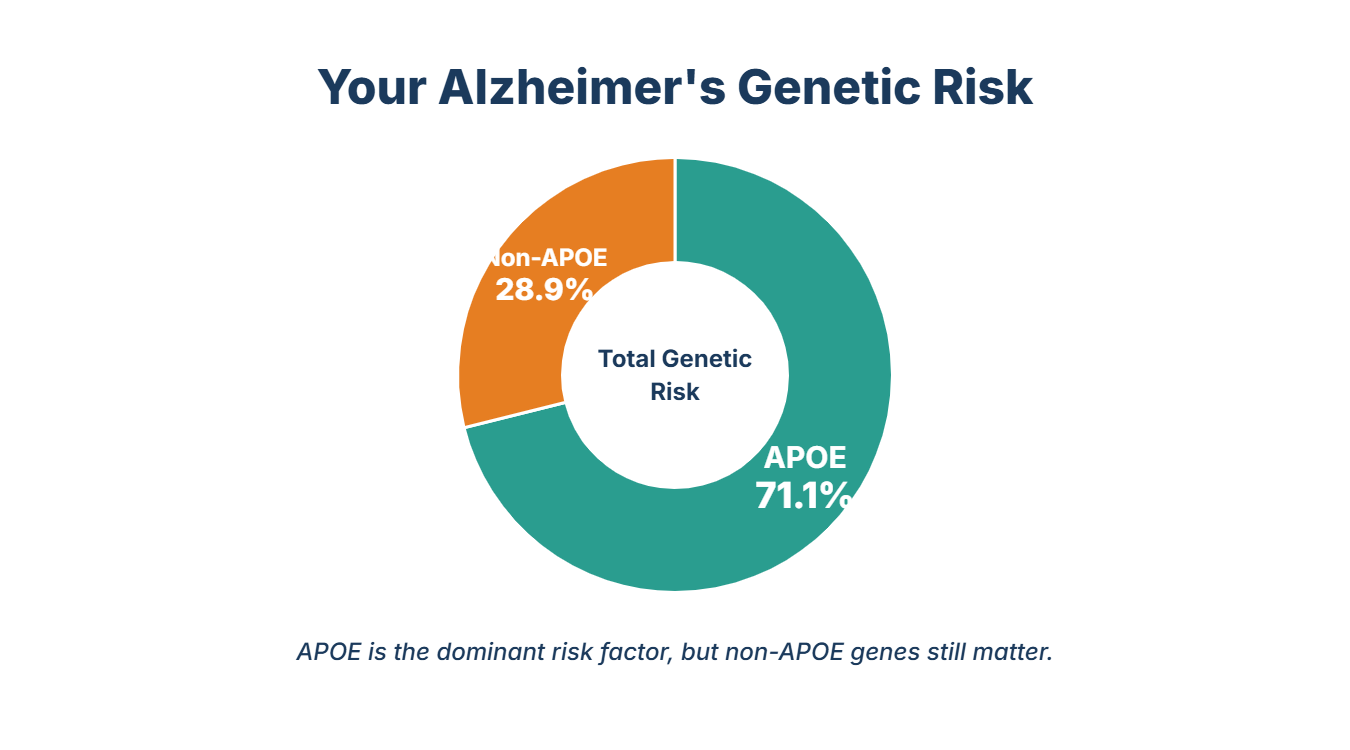
What if I told you that 71.1% of your genetic risk for Alzheimer's comes from just one gene?
And what if I told you that the other 28.9% comes from multiple other genes working together?
That's exactly what our polygenic risk score analysis revealed. And it has huge implications for how we think about Alzheimer's risk.
What Is a Polygenic Risk Score?
A polygenic risk score (PRS) is a single number that summarizes your genetic risk for a disease:
How It's Calculated
| Step | What It Does |
|---|---|
| 1 | Identify variants associated with the disease |
| 2 | Weight each variant by its effect size |
| 3 | Sum the weighted effects |
| 4 | Generate a single risk score |
Higher score = Higher genetic risk
Why It Matters
| Reason | Explanation |
|---|---|
| Risk prediction | Identifies high-risk individuals |
| Clinical decision-making | Guides screening and prevention |
| Research | Identifies subgroups for clinical trials |
Our Polygenic Risk Score Analysis
Approach
We calculated PRS using multiple P-value thresholds:
| Threshold | Significance Level |
|---|---|
| 5 × 10⁻⁸ | Genome-wide significant |
| 1 × 10⁻⁶ | Suggestive significance |
| 1 × 10⁻⁵ | Suggestive significance |
| 1 × 10⁻⁴ | Suggestive significance |
| 0.001 | Moderate significance |
| 0.01 | Nominal significance |
| 0.05 | Nominal significance |
What We Did
For each threshold:
- Selected variants meeting the threshold
- Summed their effect sizes (β)
- Calculated PRS with APOE region
- Calculated PRS without APOE region
- Calculated APOE contribution percentage
The Results
At Genome-Wide Significance (P < 5 × 10⁻⁸)
| Component | Contribution |
|---|---|
| APOE | 71.1% |
| Non-APOE | 28.9% |
At Nominal Significance (P < 0.05)
| Component | Contribution |
|---|---|
| APOE | ~71% |
| Non-APOE | ~29% |
The relative contribution of non-APOE variants remained stable as we relaxed the P-value threshold.
What 71.1% Means
The Good News
- APOE is the dominant risk factor: If you want to know your Alzheimer's risk, knowing your APOE genotype is the most informative single piece of information.
- Risk prediction is possible: APOE genotyping is available and affordable.
- High-risk individuals can be identified: APOE4 carriers can be identified for early intervention.
The Cautionary Note
- 71.1% is not 100%: APOE doesn't explain all genetic risk.
- Non-APOE variants matter: The remaining 28.9% is substantial.
- Other factors matter: Environment, lifestyle, and other genes also contribute.
The Practical Implication
| Scenario | Recommendation |
|---|---|
| APOE4 carrier | Consider genetic counseling, early screening, lifestyle interventions |
| APOE4 carrier + other risk variants | Highest risk, consider clinical trial participation |
| APOE4 non-carrier | Still at risk (non-APOE variants matter) |
| Multiple non-APOE risk variants | Increased risk even without APOE4 |
The 28.9%: What's in There?
Our gene-based analysis identified five non-APOE genes:
| Gene | Contribution |
|---|---|
| BIN1 | Modest but significant |
| PICALM | Modest but significant |
| CLU | Modest but significant |
| TREM2 | Modest but significant |
| ABCA7 | Modest but significant |
Together, these genes contribute to the 28.9% non-APOE risk.
Why This Matters
- Multiple pathways: Non-APOE genes implicate different biological pathways
- Therapeutic targets: These genes represent potential drug targets
- Risk prediction: Including non-APOE variants improves risk prediction
Comparing PRS to Other Risk Factors
Genetic vs. Non-Genetic Risk
| Factor | Contribution |
|---|---|
| APOE genotype | ~25% of overall risk |
| Non-APOE genetic variants | ~10% of overall risk |
| Age | Strongest risk factor |
| Family history | Significant |
| Lifestyle factors | Modifiable |
Genetics matter, but they're not everything.
Practical Implications
| Risk Factor | Actionable? |
|---|---|
| APOE genotype | Not modifiable |
| Non-APOE genetics | Not modifiable |
| Age | Not modifiable |
| Family history | Not modifiable |
| Lifestyle | MODIFIABLE ✅ |
| Environment | MODIFIABLE ✅ |
You can't change your genetics, but you can change your lifestyle.
The Future of Risk Prediction
Current State
- APOE genotyping: Available and affordable
- Polygenic risk scores: Becoming available
- Integration with other factors: Still developing
Future Directions
| Development | Timeline |
|---|---|
| Better PRS models | 1-3 years |
| Integration with biomarkers | 3-5 years |
| Clinical implementation | 5-10 years |
| Personalized prevention | 5-10 years |
The Bottom Line
- APOE contributes 71.1% of genome-wide significant risk
- Non-APOE variants contribute 28.9% of risk
- APOE is the dominant risk factor but not the only one
- Complete risk assessment requires both APOE and non-APOE variants
- Lifestyle factors are modifiable and matter
Your Alzheimer's risk is determined by multiple factors. APOE is the biggest genetic contributor, but it's not the whole story.
Key Takeaways
| Finding | Implication |
|---|---|
| APOE = 71.1% of risk | Dominant genetic factor |
| Non-APOE = 28.9% of risk | Still substantial |
| Multiple genes contribute | Complex genetic architecture |
| PRS can predict risk | Clinical applications possible |
| Lifestyle matters | Modifiable risk factors |
What do you think?
0 Responses
Osaghale L, Beshiru A, Subhan U. (2026). Replication-guided functional genomic prioritization of regulatory risk variants in Alzheimer's disease. Gene Reports. 44: 102551.
Code Availability: https://github.com/Oselin1988/GWAS_AD
Next post: "BIN1: The Synaptic Gene That Could Hold the Key to Alzheimer's" — Coming soon!
← Back to Blog Home