How One Gene Connects Synaptic Function to Neurodegeneration
Your brain has approximately 100 billion neurons. Each neuron forms thousands of connections (synapses) with other neurons. That's trillions of connections, all working together to make you who you are.
But what happens when those connections start to fail?
BIN1 might hold the answer.
What Is BIN1?
| Characteristic | Detail |
|---|---|
| Full name | Bridging integrator 1 |
| Location | Chromosome 2 |
| Function | Endocytosis, synaptic vesicle recycling, membrane curvature |
| Expression | High in neurons |
| Association with Alzheimer's | One of the most replicated genes after APOE |
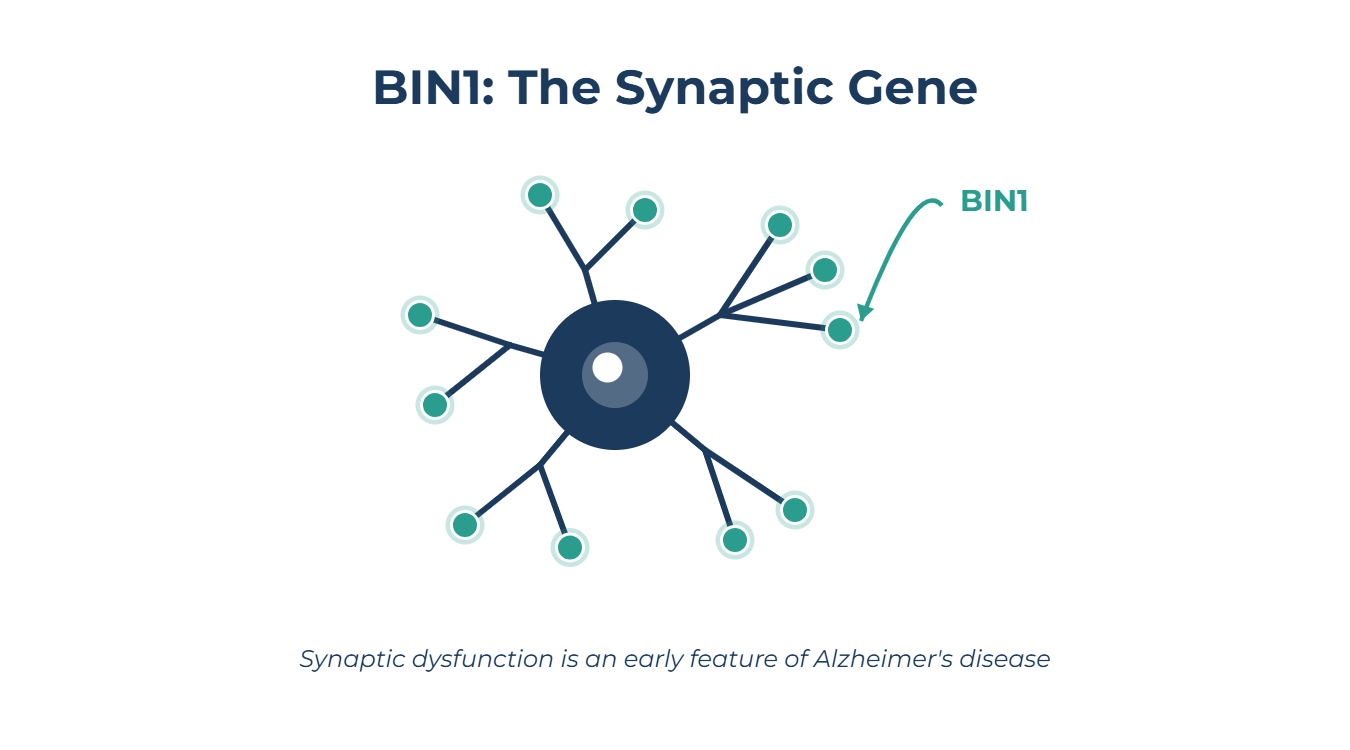
BIN1 is a protein that helps neurons maintain their connections.
How BIN1 Works
1. Endocytosis
BIN1 is involved in endocytosis—the process by which cells take in molecules from outside:
| Function | What It Does |
|---|---|
| Membrane curvature | Helps form vesicles |
| Protein recruitment | Brings other proteins to the membrane |
| Vesicle formation | Facilitates vesicle budding |
2. Synaptic Vesicle Recycling
At synapses, BIN1 is essential for:
| Function | What It Does |
|---|---|
| Vesicle recycling | Recycles synaptic vesicles |
| Neurotransmitter release | Supports synaptic transmission |
| Synaptic maintenance | Maintains synapse structure and function |
3. APP Processing
BIN1 also affects amyloid precursor protein (APP) processing:
| Function | What It Does |
|---|---|
| APP trafficking | Affects where APP goes |
| Amyloid production | Influences amyloid-beta production |
| Synaptic APP | Affects APP at synapses |
BIN1 and Alzheimer's
What We Found
In our gene-based analysis, BIN1 reached Bonferroni-corrected significance:
| Metric | Value |
|---|---|
| P-value | 5.20 × 10⁻¹⁵ |
| Significance | Bonferroni-corrected |
| Pathway | Endocytosis, synaptic function |
What This Means
| Implication | Detail |
|---|---|
| BIN1 is a true Alzheimer's risk gene | Highly significant association |
| Synaptic function matters | Implicates synaptic dysfunction |
| Endocytosis matters | Implicates cellular trafficking |
| Multiple pathways involved | BIN1 connects to several Alzheimer's mechanisms |
Why BIN1 Matters
1. Synaptic Dysfunction Is Early
Synaptic dysfunction is an early feature of Alzheimer's disease:
| Observation | Implication |
|---|---|
| Synaptic loss occurs early | Before cell death |
| Synaptic loss correlates with cognitive decline | More loss = more decline |
| Synapses can be restored | Potential therapeutic target |
BIN1 may play a role in this early synaptic dysfunction.
2. Endocytosis Is Critical
Endocytosis is involved in multiple Alzheimer's processes:
| Process | Role of Endocytosis |
|---|---|
| APP processing | APP is internalized and processed |
| Amyloid clearance | Ccells internalize amyloid-beta |
| Synaptic function | Synaptic vesicles are recycled |
| Neuroinflammation | Immune cells use endocytosis |
BIN1 is central to all of these processes.
3. BIN1 Is Connected to Other Alzheimer's Genes
| Gene | Relationship to BIN1 |
|---|---|
| PICALM | Works together in endocytosis |
| SORL1 | Also involved in APP trafficking |
| APOE | May interact with BIN1 function |
BIN1 is part of a network of Alzheimer's genes.
The Evidence
Genetic Studies
| Finding | Implication |
|---|---|
| BIN1 variants are associated with Alzheimer's | Strong genetic evidence |
| BIN1 expression is altered in Alzheimer's | Functional relevance |
| BIN1 levels correlate with disease severity | Clinical relevance |
Functional Studies
| Finding | Implication |
|---|---|
| BIN1 affects synaptic function | Mechanism of action |
| BIN1 affects APP processing | Connection to amyloid |
| BIN1 affects tau pathology | Connection to tau |
Therapeutic Implications
Potential Strategies
| Strategy | How It Would Work |
|---|---|
| Enhance BIN1 function | Improve endocytosis and synaptic function |
| Modulate BIN1 activity | Balance BIN1 levels |
| Target BIN1 pathway | Affect downstream effectors |
Challenges
| Challenge | Why It Matters |
|---|---|
| Multiple BIN1 isoforms | Different isoforms may have different functions |
| Context-dependent effects | BIN1 may work differently in different cells |
| Need for specificity | Avoid unintended effects |
What We Still Don't Know
1. Which BIN1 Variants Are Causal?
We've identified that BIN1 is associated with Alzheimer's, but we don't know which specific variants are causal.
2. How Does BIN1 Work in Different Cell Types?
BIN1 is expressed in multiple cell types. Its function may vary by cell type.
3. How Does BIN1 Interact with APOE?
BIN1 and APOE may work together in Alzheimer's pathogenesis.
4. Is BIN1 a Therapeutic Target?
We need more research to determine if BIN1 can be targeted therapeutically.
The Bottom Line
- BIN1 is a true Alzheimer's risk gene (P = 5.20 × 10⁻¹⁵)
- BIN1 is involved in synaptic function and endocytosis
- Synaptic dysfunction is an early feature of Alzheimer's disease
- BIN1 represents a potential therapeutic target
- More research is needed to understand BIN1's precise role
Understanding BIN1 could help us preserve synaptic function and prevent cognitive decline.
Key Takeaways
| Finding | Implication |
|---|---|
| BIN1 = Alzheimer's risk gene | Strong genetic evidence |
| BIN1 affects synapses | Synaptic dysfunction is key |
| BIN1 affects endocytosis | Cellular trafficking matters |
| BIN1 is a potential target | Therapeutic opportunities |
What do you think?
0 Responses
Osaghale L, Beshiru A, Subhan U. (2026). Replication-guided functional genomic prioritization of regulatory risk variants in Alzheimer's disease. Gene Reports. 44: 102551.
Code Availability: https://github.com/Oselin1988/GWAS_AD
Next post: "PICALM: The Cellular Recycling Gene That Affects Alzheimer's Risk" — Coming soon!
← Back to Blog Home